Public companies now hold approximately 1.29 million BTC across nearly 200 corporate balance sheets as of October 2026. For much of the past two years, the prevailing treasury strategy focused on accumulating Bitcoin and maintaining holdings in custody. That model is beginning to evolve. New Bitcoin collateral infrastructure, including Sui’s Hashi network, is preparing to launch this month, offering institutional access to Bitcoin collateral markets with more than $500 million in announced capital commitments. Meanwhile, Nasdaq listed Zhibao Technology announced a strategic collaboration with Bedrock on October 12 to explore deploying part of its 2,380 BTC treasury into onchain infrastructure, with institutional custody and compliance considerations forming part of the proposed framework.
Each of these structures has to answer the question a treasury manager will be asked by their board: who controls the Bitcoin once it leaves custody to work onchain. Deploying into DeFi has usually meant transferring it to an intermediary that holds it on the institution's behalf, and that transfer is where most of the counterparty risk in the trade sits.
In short: Institutions can deploy Bitcoin into DeFi without a centralized custodian by separating the Bitcoin from the instrument that moves onchain. The Bitcoin stays reserved in its own UTXO under threshold cryptography, while a 1:1 claim such as tBTC is deployed in its place. Redemption rights stay with an account the institution already controls, and anyone running a Bitcoin node can verify the reserve.
Onchain Bitcoin Is Mostly Being Borrowed Against
A snapshot of the tBTC contract on Ethereum at block 26,141,569 counts 4,152.96 tBTC on the network. Roughly 48% of it sits in Bitcoin-backed lending markets, which makes credit the largest single use of the asset.
Across the network, the supply splits into four uses:
- Lending markets, about 48%. Aave alone holds 41.5% of all tBTC on Ethereum, roughly 1,725 tBTC, and three smaller lending markets add a further 6.1%.
- Outside the listed protocols, 32.7%. This is tBTC the snapshot does not attribute to any of the integrated venues it tracks.
- Ethereum layer 2 networks, 10.5%. tBTC bridged onward to networks built on Ethereum.
- DEX liquidity, 8.1%. tBTC supplied to trading pools.
Holders are mostly posting Bitcoin as collateral and borrowing against it. Deploying Bitcoin into DeFi is in practice a financing decision, so the party a treasury has to evaluate is the market it borrows from.
In a Lending Market, the Counterparty Is a Rulebook
A centralized lending desk sets its terms by contract and decides how it treats collateral on its own. When several such desks failed in 2022, one large lender's terms had treated deposited assets as loans to the platform, and its bankruptcy filing showed roughly $4.7 billion owed to users.
An onchain lending market publishes its terms as code instead. The two models differ on the points a risk committee checks first:
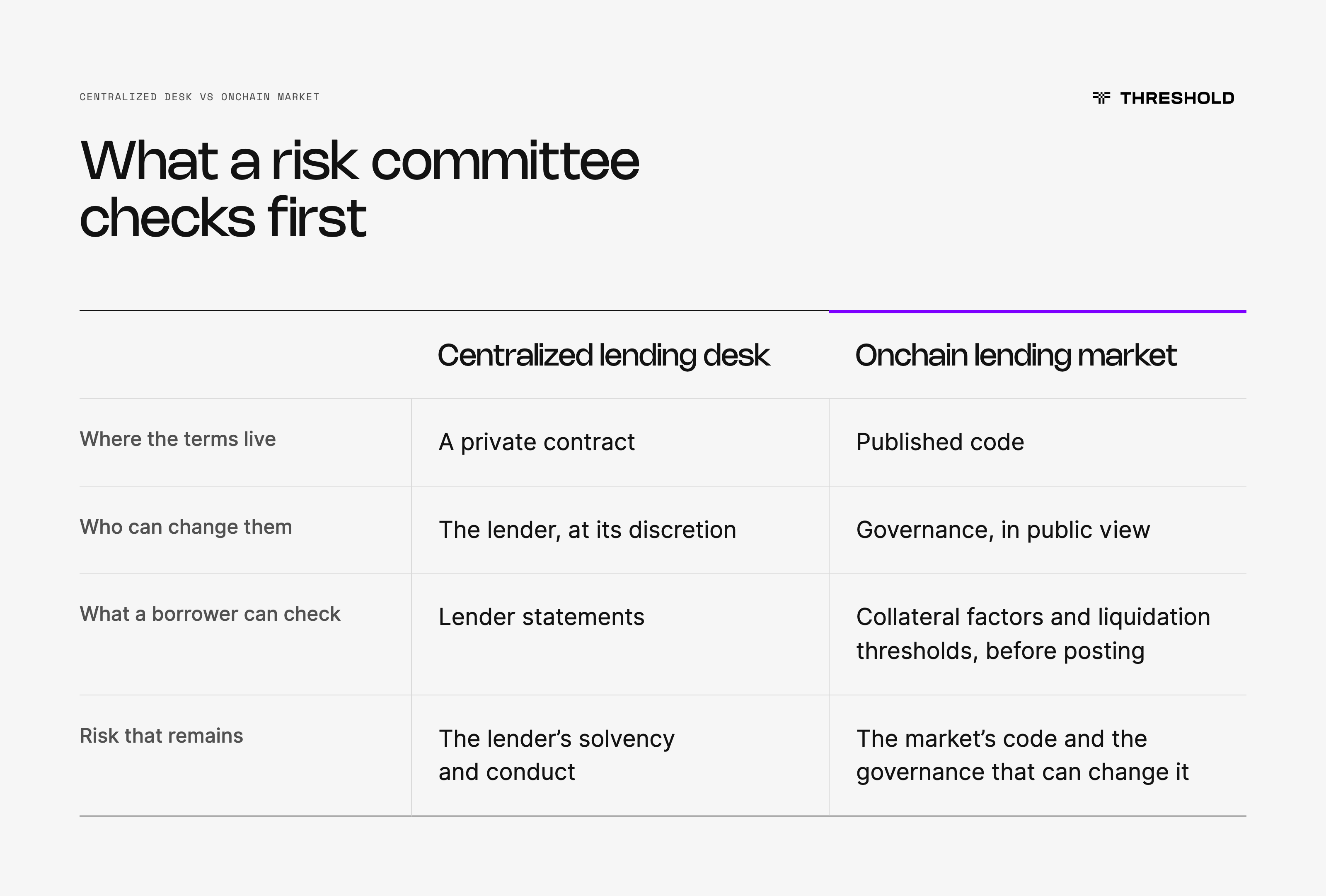
The onchain model takes the discretionary custodian out of the financing trade, though venue risk stays. That risk attaches to whatever asset is posted as collateral, so the structure of the collateral decides how far it travels:
- Bitcoin posted directly. Every venue event, from a liquidation to a contract failure, reaches the treasury's reserve.
- A 1:1 claim posted against reserved Bitcoin. Liquidations and venue failures affecting the claim do not reach the reserved coins.
Depth Is the Constraint Institutions Will Hit First
The same snapshot shows how concentrated onchain Bitcoin credit is. One market holds about 87% of the tBTC sitting in listed lending venues, so a treasury deploying today would in practice be taking that market's code and governance as its main venue exposure.
Size raises a second question. Public companies hold about 1.29 million BTC, and 1% of that, roughly 12,850 BTC, is more than three times the 4,153 tBTC currently on Ethereum. A treasury deploying a quarter of a 2,380 BTC reserve would add about 595 BTC, around 14% of today's Ethereum tBTC supply.
Those numbers set the diligence questions a treasury manager should ask before choosing a venue:
- Capacity. Can the target market's supply caps absorb the position?
- Share. What portion of the market would the position represent once it is in place?
- Exit. How long would the position take to unwind through that market's liquidity under stress?
- Governance. Who can change the market's parameters while the position is open, and with how much notice?
Keeping the Reserve Out of the Venue
Verifiable Bitcoin Accounts are Threshold's structure for separating the reserve from the venue. The Bitcoin stays in the institution's existing custody arrangement in its own reserved output, and only tBTC minted against it goes to a lending market; the mechanics are set out in the launch post and mapped against a full custody review in Who Controls the Bitcoin?
For the financing decision, the useful property is that venue selection and custody stop being the same choice. A treasury can size its tBTC position to what a market can absorb while the reserve behind it stays where its auditors already expect to find it. That matches how institutions say they want to operate, with 53% of respondents in the 2026 EY-Parthenon and Coinbase survey preferring a traditional finance platform with crypto capabilities that keeps digital assets inside existing portfolio and risk processes.
Where This Stands
Status: pre-deployment. Verifiable Bitcoin Accounts are not live yet, and the first live position depends on steps governed by the protocol. Treasury teams evaluating the model now can review the architecture and legal structure ahead of launch through the diligence pack, which is led by a custody-and-control brief that cites the code behind each claim and is available to qualified institutional participants on request. Request the Diligence Pack
Frequently Asked Questions
- Can an institution use Bitcoin in DeFi while keeping its existing custodian?
Yes. A Verifiable Bitcoin Account is funded with one Bitcoin transaction and operated from an Ethereum account within the institution's current custody stack, so the existing custodian relationship stays in place.
- How is tBTC different from custodial wrapped Bitcoin?
Custodial wrapped Bitcoin relies on a single issuer holding a pooled reserve. tBTC is minted against Bitcoin secured by a 51-of-100 threshold signer set. With Verifiable Bitcoin Accounts. the coin sits in segregated accounts within the BTC network.
- Is the reserved Bitcoin ever lent or rehypothecated?
With Verifiable Bitcoin Account, the reserved Bitcoin is excluded from lending and pledging by design. The protocol and its signers reject any attempt to combine a position's UTXO with any other funds.
- How does a treasury or audit team verify a position?
Each position can be located directly from its Bitcoin outpoint. Every movement is a single-input, single-output transaction, so any Bitcoin node can reconstruct the full lineage back to the original deposit.
- Are Verifiable Bitcoin Accounts live?
They are pre-deployment, and the first live position depends on protocol governance steps. Qualified institutions can request the diligence pack ahead of launch.
Check other Bitcoin Markets available onchain
.png)
.png)