.png)
September was a month of quiet but meaningful groundwork for Threshold, as the team focused on making tBTC stronger from the inside out. These efforts also address forward-looking technical specifications for VBA (Verifiable Bitcoin Accounts) version 1, enabling diligence teams to review every part of the account design before any Bitcoin is committed.
September also brought new research from Alea Research on Bitcoin-backed lending and continued focus on borrowing against Bitcoin with tBTC. Mid-month, Threshold Network joined the European Blockchain Convention in Barcelona to discuss what comes next for institutional Bitcoin.
Highlights
- Threshold Network published the technical specification for Verifiable Bitcoin Accounts, defining how each BTC remains segregated.
- Threshold began an expanded round of security checks and maintenance updates on the tBTC bridge, building on the bridge security work shared in August.
- A new release from Alea Research highlights tBTC’s $368.6M custody base and its strong market fit in institutional lending markets.
- The VBA pipeline continues to strengthen, with positive feedback from prospects so far.
- Threshold participated in the European Blockchain Convention in Barcelona last September, creating new opportunities for institutional engagement.
Milestones
Technical Specification of Verifiable Bitcoin Accounts
The Verifiable Bitcoin Accounts specification defines how an institution opens and closes a segregated Bitcoin position. An institution funds a Verifiable Bitcoin Account with a single Bitcoin transaction from the custody setup it already operates. It then signs from an Ethereum account inside that same custody stack, so its existing arrangements stay unchanged.
Each account's coins are reserved as their own identified UTXOs and are never pooled with other users' Bitcoin. Against that reservation, tBTC is minted to an address the owner nominates. The owner decides where that tBTC goes, and the reserved Bitcoin is unaffected by what happens to it on-chain.
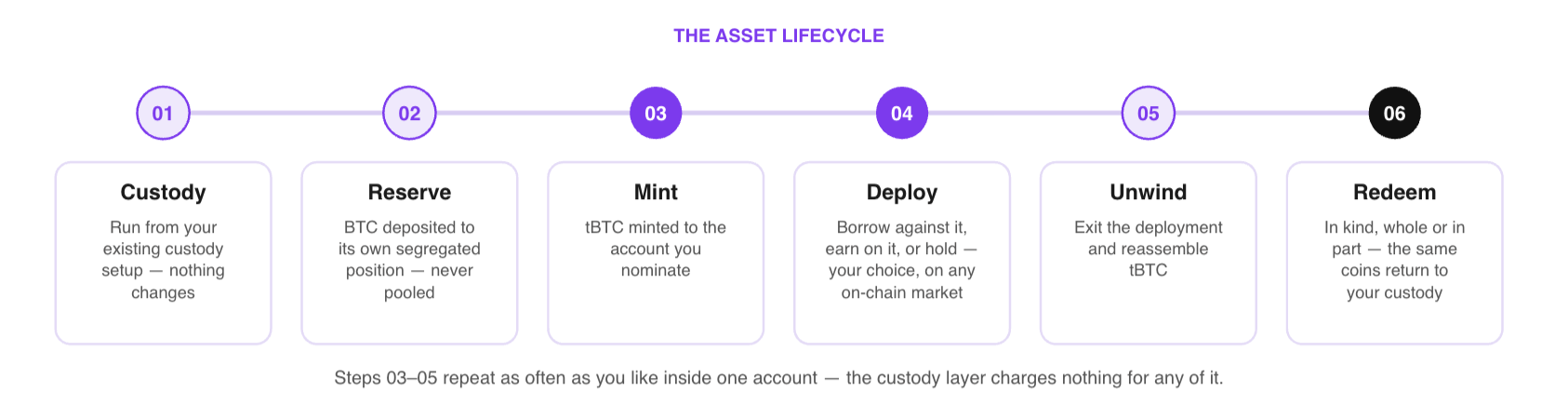
Redemption in a Verifiable Bitcoin Account is in kind, returning the same coins that were reserved. Only the account address controlled by the owner can redeem or extend the position. Redemption can be taken in whole or in part, and repeatedly, at any time before the account's expiry.
Anyone running a Bitcoin node can verify a Verifiable Bitcoin Account by inspecting its anchor UTXO and on-chain ownership record. That check traces the position's full lineage, which is what makes the account verifiable.
"Institutions don't need additional layers of trust; they need systems where outcomes are defined and verifiable from the outset."
- MacLane Wilkison, Co-Founder of Threshold Network
Security Checks and Updates on the tBTC Bridge
Most of September went into maintenance, and security hardening across the stack. The team worked through the core components that secure tBTC, including the signing library, the bridge contracts, the node software, stress testing, tightening code paths and expanding test coverage.
FROST and Schnorr signing moved forward. Work continued on moving tBTC’s threshold signing to FROST, a modern Schnorr-based scheme. Schnorr signatures align tBTC with Bitcoin’s Taproot upgrade, and FROST is designed to make the signing process simpler and more robust. This remains one of the team’s core priorities heading into Q4.
The month closed with routine housekeeping: outdated configurations and a deprecated integration were retired, and regular security maintenance was carried out across the protocol’s tooling.
Ecosystem Growth
Highlights on Bitcoin-backed Credit Loans
Borrowing against Bitcoin has always been part of what tBTC makes possible. But as Q3 2026 came to a close, the terms on offer made it worth a fresh look, especially for anyone who believes in Bitcoin for the long haul.
The idea is simple. Instead of selling Bitcoin to raise cash, tBTC holders can borrow up to 73% loan-to-value against it. Their long-term BTC exposure stays on the balance sheet, positions stay intact, and funding needs still get met. There's no forced choice between conviction and liquidity.
The cost of that flexibility has been notably low. As of September 24, 2026, borrow rates for Bitcoin-backed credit with tBTC stood at 4% in US dollars and 2.5% in euros. For treasury teams, that opens a practical path to cover expenses or meet obligations without selling their core Bitcoin asset.

Community and Events
European Blockchain Convention, Barcelona
RC Ramos, Head of Marketing, represented Threshold Network at the European Blockchain Convention in Barcelona. The conversations centered on what comes next for institutional Bitcoin through Verifiable Bitcoin Accounts and where institutional demand is heading.

Media Highlights
Alea Research report
Alea Research published an analysis of where Threshold Network's institutional accounts sit in Bitcoin-backed lending. The report highlights 3 parts:
- DeFi usage: Aave and Curve are tBTC’s main venues. Aave deposits topped 2,000 tBTC in July, then slipped to about 1,750 by mid-August. Yield vaults held $24.6M in July, about 93% of it in Yield Basis.
- The T token angle. Staking 100,000 T gives users a fee allowance of 0.001 tBTC per rolling 30 days. That covers the fee on roughly 0.5 BTC of mint/redeem activity. This is a fee discount for active users, not passive yield, and unstaking takes 30 days. T holders also vote on fees and the treasury, and the treasury sometimes buys back T at its own discretion. The report notes T rose 33.6% over the period.
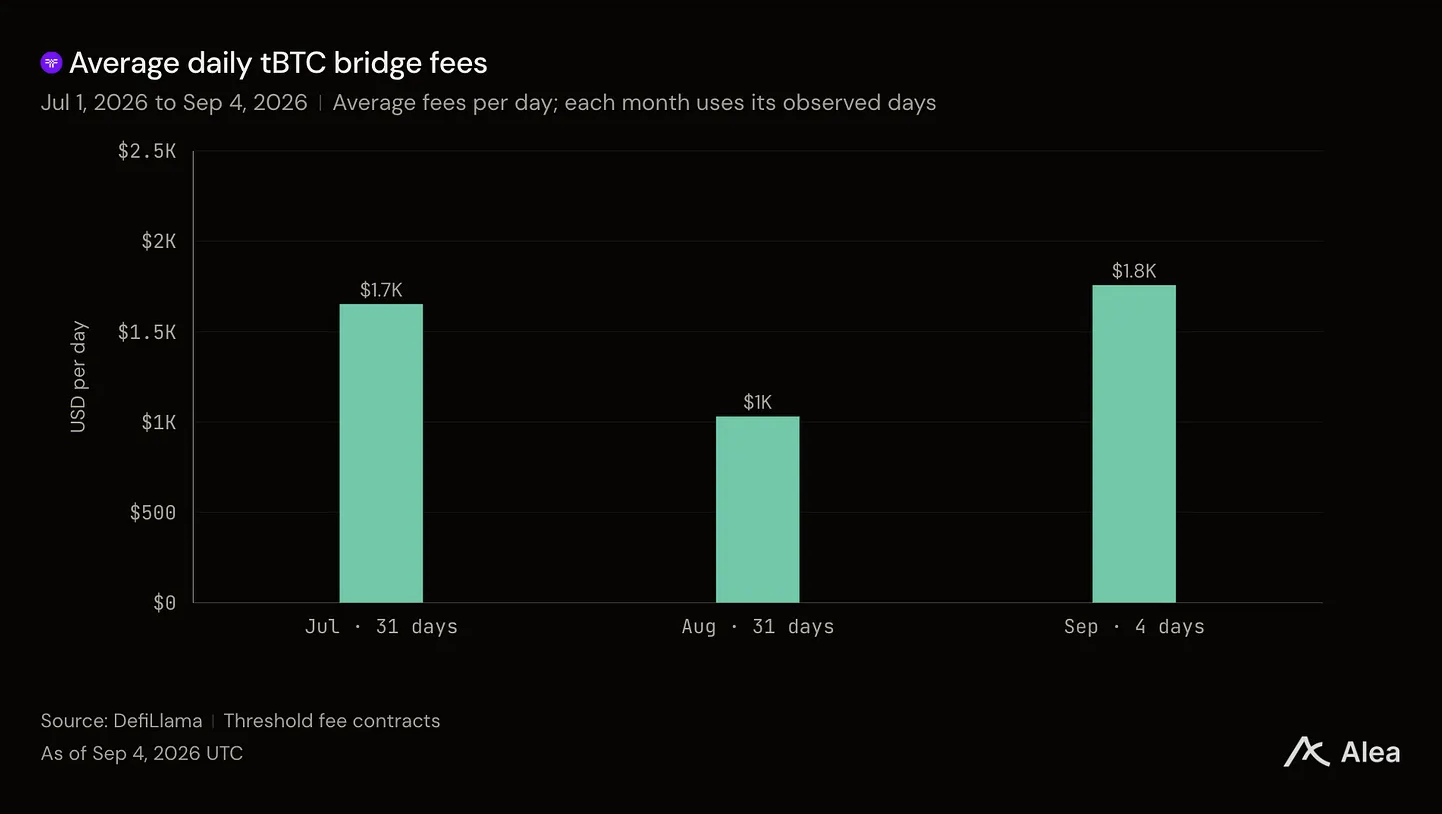
- The report argues that institutional borrowing is Threshold’s growth opportunity. More mint/redeem activity would mean more fees and more reason to stake T. The underlying data is mixed, though: BTC deposits and fee income both declined in Q3.
Holders can borrow against that Bitcoin through Verifiable Bitcoin Accounts without selling it, and the full report is available here.
Looking Ahead
Q4 builds on the groundwork laid in September. The focus stays on two connected priorities: refining Verifiable Bitcoin Accounts and strengthening the security of the tBTC bridge underneath them. Refining the VBA specification. With version 1 of the technical specification now published, the next step is refining it with the diligence teams and prospects reviewing the account design. Their feedback will help sharpen how positions are opened, extended, and redeemed, and how institutions verify them from their own Bitcoin. The goal is to answer every open question before any Bitcoin is committed, so outcomes are defined and verifiable from the outset.
Moving to FROST and Schnorr signing. The move to FROST remains one of the team’s core priorities this quarter. Schnorr-based signing aligns tBTC with Bitcoin’s Taproot upgrade and is designed to make threshold signing simpler and more robust. For institutions using Verifiable Bitcoin Accounts, that means a signing process built on the same cryptography as Bitcoin itself.
Continued security tightening. The security checks that began in September will carry into Q4. This work spans the signing library, bridge contracts, and node software, with ongoing stress testing, tighter code paths, and broader test coverage. Regular maintenance and retiring outdated components will continue alongside it, keeping the protocol lean as institutional activity grows.
Together, these efforts point to one outcome for Q4: an account design institutions can verify end to end, secured by signing infrastructure built for Bitcoin’s future.
Explore more ways to use tBTC On-chain
.png)