October 2026 marked an important planning milestone for tBTC. The team set out its Q4 roadmap for the transition from threshold ECDSA to FROST Schnorr signing, a significant step forward for the protocol’s signing infrastructure.
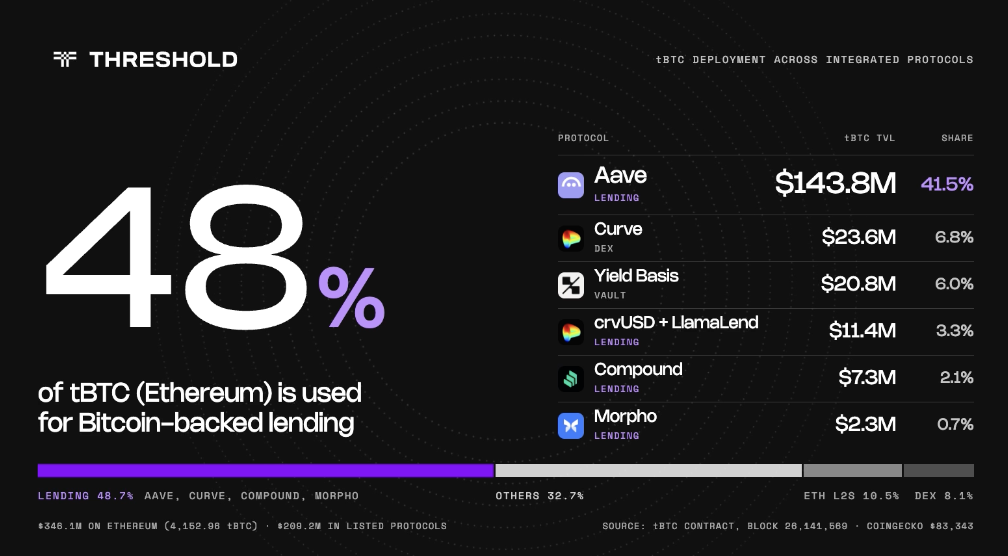
The team also tracked how far tBTC has moved into Bitcoin-backed lending. Today, 48% of all tBTC on Ethereum is deployed as lending collateral, a strong sign of its growing utility across DeFi. Security remained front and center. The team kept a close watch on the bridge’s health and stayed up to date with the latest vulnerability scans, so that tBTC stays resilient as it grows.
Threshold also released two new institutional guides framed the month for treasury and diligence teams. The first sets out a six-category due diligence framework for evaluating who controls institutional Bitcoin, and the second explains how Verifiable Bitcoin Accounts let institutions take part in onchain lending while keeping Bitcoin in segregated, auditable accounts.
Highlights
- Threshold published tBTC's Q4 bridge roadmap, moving threshold signing from ECDSA (GG18) to FROST Schnorr while keeping the 51-of-100 signer quorum.
- As of October 7, 2026, 48% of tBTC on Ethereum was deployed as collateral in lending markets, with Aave holding about $144M.
- A new article explains how Verifiable Bitcoin Accounts give institutions access to onchain lending while their Bitcoin stays in segregated, auditable accounts.
- Threshold published a six-category due diligence framework institutions can use to assess who controls their Bitcoin.
Milestones
tBTC Bridge Roadmap: ECDSA to Schnorr
tBTC's Q4 roadmap centers on migrating the bridge's threshold signing from ECDSA to FROST, a Schnorr-based scheme. The update aims to tighten security and shorten bridge latency across mint and redemption processing.
Today tBTC signs with threshold ECDSA under the GG18 protocol. The limits of GG18 belong to the cryptography itself and are shared by every ECDSA-based threshold signing network. A failed round rarely shows which signer caused it, and each failure restarts with a new quorum, adding latency and a denial-of-service surface.
For institutions, the signer quorum stays at 51 of 100 through the transition, so the trust model holds while the signing process becomes faster. Schnorr signatures also align tBTC with Bitcoin's Taproot upgrade, and technical specifications are available in the Threshold documentation.
Understanding Bitcoin Custody: A Due Diligence Framework for Institutions
On October 1, 2026, Threshold published Who Controls the Bitcoin? A Due Diligence Framework for Institutions. The article gives diligence teams a reusable six-category framework for evaluating who can actually move institutional Bitcoin, covering custody, key control, verification and recovery.
The framework also sets out how Bitcoin custody works with Threshold and tBTC. That question carries more weight as Bitcoin moves deeper into institutional financial structures, where key control has to be documented before any position is opened.
Ecosystem Growth
48% of tBTC (Ethereum) Is Used for Bitcoin-backed Lending
As of October 7, 2026, tBTC supply on Ethereum stood at $346.1M (4,152.98 tBTC), and 48% of it was deployed as collateral in lending markets. Aave alone held $143.8M, or 41.5% of tBTC on Ethereum.
On October 15, 2026, Threshold published Moving Institutional Bitcoin From Passive Custody to Lending Markets, which covers how treasuries can deploy Bitcoin in lending markets while keeping asset segregation and control. The article frames the market opportunity in numbers: Bitcoin-backed lending reached $73.6 billion in 2025 and is projected to exceed $90 billion by the end of 2026.
Verifiable Bitcoin Accounts are how institutions reach that market through Threshold. An institution can take part in onchain lending while its Bitcoin stays in segregated, auditable accounts, and the September 2026 recap covers how each account reserves its own identified UTXOs.
Safeguarding T Token
In the wake of the Binance security breach on October 29, the DAO acted decisively to protect the ecosystem by withdrawing onchain liquidity for $T. By removing that availability, in reduced the attacker’s most direct path to dumping the stolen tokens, which limited downward pressure on the market and protected existing holders. As a precaution, withdrawals of T on Binance remain paused until Binance acquires more T tokens to re-enable it. We’ll share updates as they become available, and we thank the community for its patience and support.
Looking Ahead
Q4 has two priorities: tightening security and moving the bridge to Schnorr signing.
On security, the team will keep monitoring the bridge closely and running regular vulnerability scans. On signing, the move from threshold ECDSA (GG18) to FROST Schnorr will continue through the quarter. The 51-of-100 signer quorum stays the same, so the trust model doesn’t change. What changes is that failed signing rounds will be easier to trace, and minting and redemptions should get faster. Technical details will be posted in the Threshold documentation as the work moves forward.
Explore more ways to use tBTC On-chain