
Key takeaways
- Holding Bitcoin and pledging it as collateral are two different risk decisions. The risk profile shifts the moment BTC is pledged, even if market exposure has not moved.
- Four issues follow: the asset becomes encumbered, mark-to-market risk becomes liquidation risk, custody becomes part of the credit file, and recovery can depend on counterparties if it is not specified at approval.
- Those issues reduce to two questions a risk team has to answer at all times: who can move or liquidate the collateral, and who can independently verify its state.
- Verifiable Bitcoin Accounts keep native BTC in a multi-party construct enforced in Bitcoin Script. tBTC is the transferable claim posted to the lending venue. They are linked 1:1. They are not the same asset for mandate purposes. Confirm tBTC is approved collateral before an investment committee sees the trade.
- Shared on-chain marks let both sides read the same loan-to-value. That closes reconciliation disputes. It does not remove liquidation risk. On many venues it makes a forced sale faster, not slower.
- Test before deploying: both sides can verify state at any time; the recovery path is written at approval; named parties match the control matrix; tBTC is a permitted asset under the mandate.
Same Bitcoin, different risk profile
A Bitcoin position held in treasury and the same Bitcoin pledged as collateral against a loan can look identical on a balance sheet. Both are denominated in BTC, both track the same market, and both may sit with the same custodian on the same day. The difference appears the moment the asset is asked to do something beyond being held.
A passive treasury position carries market risk, and opportunity risk. The institution decides when it moves, whether it is sold, and who is permitted to sign for it. Once that same Bitcoin is used as collateral, it takes on obligations that did not exist before. It now supports a financing arrangement, answers to a set of loan terms, and can be moved or liquidated under conditions the institution does not fully control on its own.
Understanding those changes before deployment, in a market where the custody model increasingly decides where institutional Bitcoin can go, is the difference between an informed collateral decision and an approval that quietly imports risks nobody reviewed.
Four problems when Bitcoin becomes collateral
Pledging Bitcoin adds a layer of obligations on top of the market position an institution already holds. Four of those obligations matter most to a treasury or risk team.
- The asset becomes encumbered. Pledged Bitcoin is bound by loan terms and liquidation triggers, so the institution no longer fully controls when it moves or whether it can be sold. The exposure is unchanged, but the freedom around it is not.
- Market risk becomes collateral risk. A price decline that would simply be uncomfortable for a held position can force action for a pledged one. Pledge 10 million dollars of BTC against a 5 million dollar loan at 50 percent loan-to-value, and a 25 percent drop lifts that ratio to about 67 percent, close enough to a threshold to trigger a margin call or a forced sale on a deadline.
- Custody becomes part of the credit decision. Once Bitcoin secures financing, safekeeping is no longer the only question. The institution has to know who controls the collateral while the loan is open, and whether both sides can verify the position independently.
- Recovery is uncertain. Getting the Bitcoin back cleanly matters as much as deploying it. Recovery deserves the same scrutiny at approval as the entry, since a slow or counterparty-dependent return path is a risk in its own right.
How Verifiable Bitcoin Accounts solve them
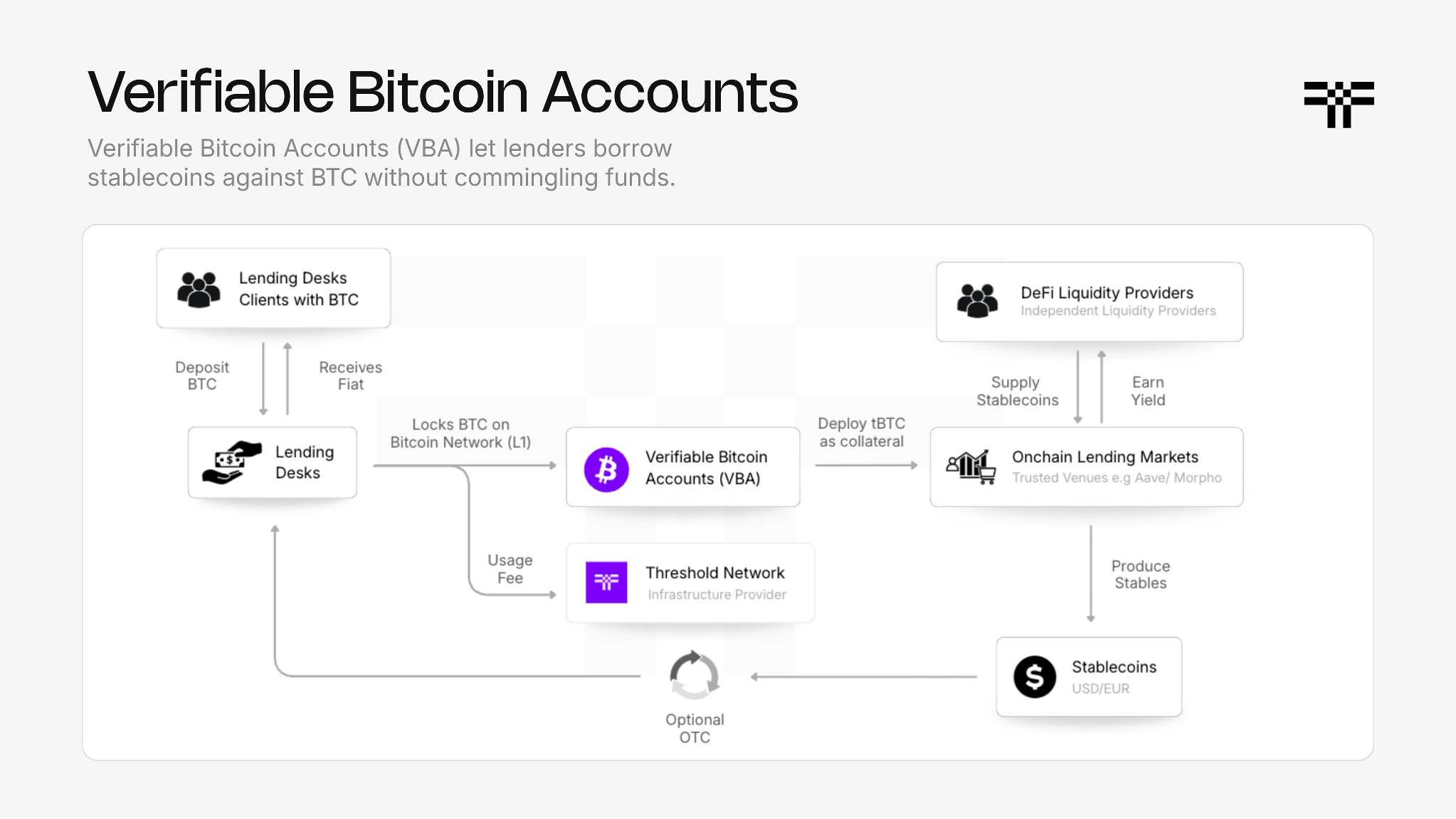
Each of these problems is, at root, a question of who controls the asset and who can verify its state. That is what Verifiable Bitcoin Accounts are built for. Combined with tBTC, a tokenized form of Bitcoin secured by threshold cryptography rather than by a single custodian, they answer the four problems directly.
- On control, multi-party signing. Verifiable Bitcoin Accounts use PSBT or Partially Signed Bitcoin Transactions, so no single party can move the asset alone and every movement follows conditions agreed in advance. Because the Bitcoin behind tBTC is not held by a single custodian, control of the backing is distributed across a signer set rather than concentrated in one place.
- On liquidation, a shared view of the position. With the position and its collateral status represented onchain, borrower and lender track the same loan-to-value at the same time, so margin conditions are read from one verifiable source instead of argued over. That closes the reconciliation gap that turns a routine drawdown into a dispute.
- On verification, independent confirmation. Both sides can confirm balances and movements directly, and the backing of tBTC is provable onchain rather than asserted by a counterparty. An institution can see the collateral it can neither move nor liquidate alone.
- On recovery, defined return paths. Verifiable Bitcoin Accounts set out how an institution recovers its Bitcoin, and tBTC redeems for native BTC, so the exit does not depend on a single counterparty staying cooperative or solvent.
None of this removes the market exposure an institution took on by holding Bitcoin. It removes the uncertainty around who controls that Bitcoin and who can prove its state, which is the part a collateral arrangement most often gets wrong.
The bottom line for institutions
Holding Bitcoin and deploying it as collateral are two different risk decisions, even when the asset on the balance sheet is the same. The allocation question asks whether an institution wants Bitcoin exposure at all. The collateral question asks whether it can keep control of that Bitcoin while the asset is working, and the second question is the one that decides whether a financing arrangement is sound.
Read together, the four problems reduce to two things an institution has to be certain of at all times: who controls the collateral, and who can verify its state. A held position rarely forces those questions, while a pledged position always does, because the moment Bitcoin secures a loan it answers to loan terms and liquidation thresholds it does not fully command. Verifiable Bitcoin Accounts and tBTC are built around those two certainties, keeping control distributed across a signer set and the position provable onchain rather than asserted by a counterparty.
That gives an investment committee a practical test to apply before any capital moves. The collateral state should be verifiable by both sides at any time, and the recovery path should be defined at approval rather than discovered under stress. Infrastructure that meets that standard can be evaluated on its merits, while infrastructure that leaves either question open is carrying risk in the gap, and that gap tends to stay invisible until the market forces it into view.
Frequently asked questions
What happens when Bitcoin is used as collateral?
The Bitcoin keeps its market exposure but becomes an encumbered asset that supports a loan. It gains obligations such as loan-to-value limits, margin requirements and liquidation triggers, and it can be moved or sold under conditions the institution no longer controls alone.
How does loan-to-value work for a Bitcoin loan?
Loan-to-value measures the loan amount against the value of the pledged Bitcoin. Because Bitcoin is volatile, a price decline raises the ratio even though the debt is unchanged, which can trigger a margin call or a top-up requirement well before the loan matures.
Can Bitcoin collateral be liquidated?
Yes. When the loan-to-value crosses a defined threshold, the agreement can allow the counterparty to sell the collateral to cover the debt, sometimes automatically and sometimes after a grace period, depending on the terms an institution accepts at signing.
Who controls Bitcoin when it is pledged as collateral?
Control depends on the custody and signing arrangement rather than on legal ownership alone. An institution should confirm who can move the asset, under what conditions, and whether the position can be independently verified while the loan is open.
Explore the institutional controls required for Bitcoin backed collateral, and see how Threshold Institutional Markets approaches custody, verification and liquidity.
.png)
.png)