tBTC is decentralized, trust-minimized tokenized Bitcoin. It brings native BTC onchain at a 1:1 peg, secured by a 51-of-100 threshold signer set rather than a single custodian, with permissionless minting and redemption. This guide maps where holders can put tBTC to work across onchain lending and liquidity venues in 2026.
Bitcoin's Liquidity Has Outgrown the Vault
For most of Bitcoin's history, "Bitcoin in DeFi" meant one thing: wrapping your BTC with the counterparty risk of a centralized custodian (like wBTC by BitGo, cbBTC by Coinbase), hoping the peg would hold. While that trade-off sufficed in the experimental stage of DeFi, the current market demands a more security-focused approach and a more diversified asset allocation. tBTC, by Threshold Network, mitigates that trade-off by securing asset across a permissionless signer set via threshold ECDSA cryptography, requiring a 51-of-100 majority to authorize mints and redemptions.
The appetite for on-chain capital efficiency is scaling rapidly. Per Galaxy Research's State of Crypto Leverage Q3 2025, crypto-collateralized lending reached an all-time high of $73.6B at the end of Q3 2025, with on-chain venues now accounting for 66.9% of that market, up from 48.6% at the prior cycle peak in Q4 2021.
Bitcoin-specific lending remains a smaller share. Ledn pegs the consumer BTC-backed loan market at ~$3B in May 2026, but the runway is substantial, with credible projections of $1T within a decade. Tailwinds are reinforced by stablecoin supply, which crossed $308B in early 2026 per DefiLlama and is on track to reach $1T by year-end. With the underlying infrastructure secured, the question becomes how to actively deploy this capital.
This guide serves as a practical blueprint for navigating the tBTC ecosystem in 2026.
How to Get tBTC: The Three Foundational Entry Points
Bringing your Bitcoin into DeFi shouldn't mean compromising on security or being forced into a single, rigid onboarding process. Because every user has different priorities, whether it’s minimizing transaction fees, staying strictly on the native Bitcoin network, or getting capital directly to an alternative Layer 2, Threshold Network provides multiple gateways to acquire tBTC. The best way to get tBTC depends entirely on what you are optimizing for.
Path 1: Direct minting from native BTC
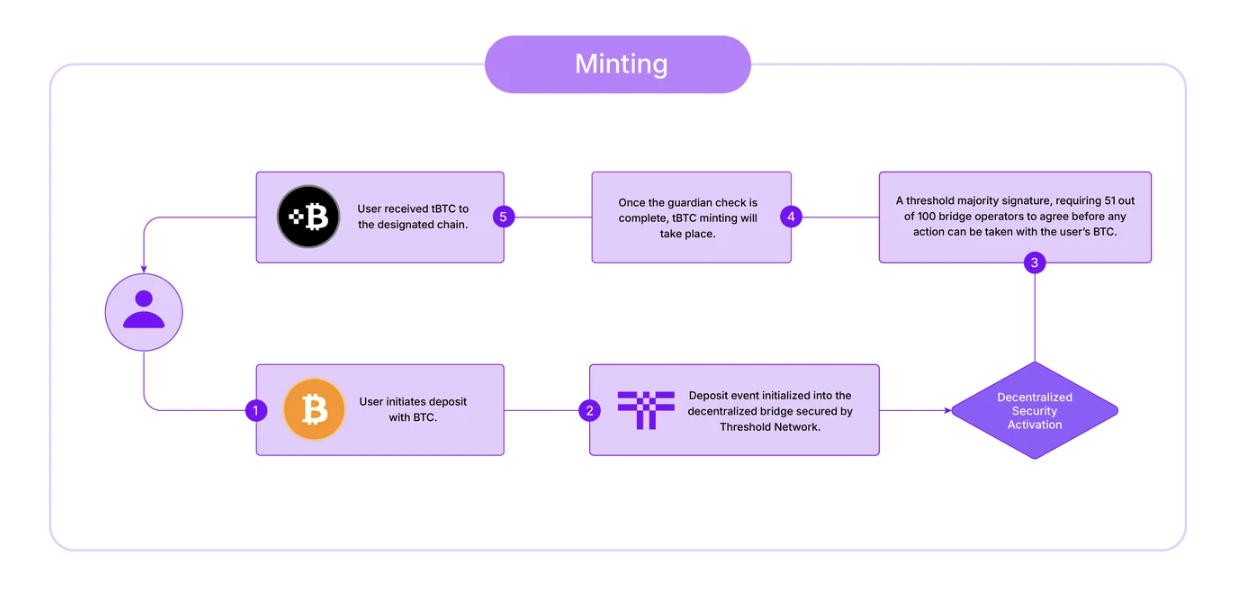
This is the trust-minimized path. You deposit native Bitcoin into a tBTC address controlled by Threshold's 51-of-100 signer set, and tBTC is minted directly on your destination chain. As of late 2025, the new Threshold Unified Router enables gasless minting, an upgrade that removes the requirement to hold ETH to complete the mint, which was one of the largest friction points for users moving large positions.
Since 2026, T token stakers can also receive a tBTC fee waiver on every mint and redemption. The T staking rebate program ties directly to your staked balance: the Threshold Unified Bitcoin Router reads your position and automatically waives the fee at the point of transaction.
The tBTC mint and redemption fee is 0.2% or 20 basis points; the rebate scales with stake size and can reach a full fee waiver, applied to both the tBTC mint fee and tBTC redemption fee.
Native tBTC minting is live on Ethereum, Arbitrum, Base, Sui, and Starknet; it is also available on Optimism, Polygon, Solana, and Hydration through bridged access.
Path 2: Multi-chain Swap to tBTC
If you already hold WBTC, cbBTC, or another tokenized wrapped BTC, the most expedient route into tBTC is by direct conversion or swapping, either through the Threshold App or via secondary liquidity venues such as Uniswap, Portal Bridge, Curve, and others (see full list here).
This path trades operational speed for two residual exposures: execution slippage at the point of swap, and continued counterparty and custody risk from the originating wrapper until settlement is complete. As of 2026, the Threshold App consolidates this flow further, supporting direct swaps and cross-chain bridging between tBTC and other tokenized Bitcoin representations through their own unified router, so positions can be accessed across supported networks within a single execution layer.

Path 3: Institutional Pathway, through Verifiable Bitcoin Accounts
Everything above reflects a user-driven flow designed for individuals. Institutional deployment follows a different structure and typically requires a more rigorous onboarding and verification process. This is the role of Verifiable Bitcoin Accounts (VBA).
Verifiable Bitcoin Accounts (VBA) is not a new wrapper. It is a deployment framework built on top of the existing tBTC signer infrastructure, the same network architecture that has operated for six years with zero losses across more than $5B in cumulative volume (Threshold Network). The framework is designed to address several structural barriers that have historically limited institutional Bitcoin deployment, all of them addressed through the features listed below:
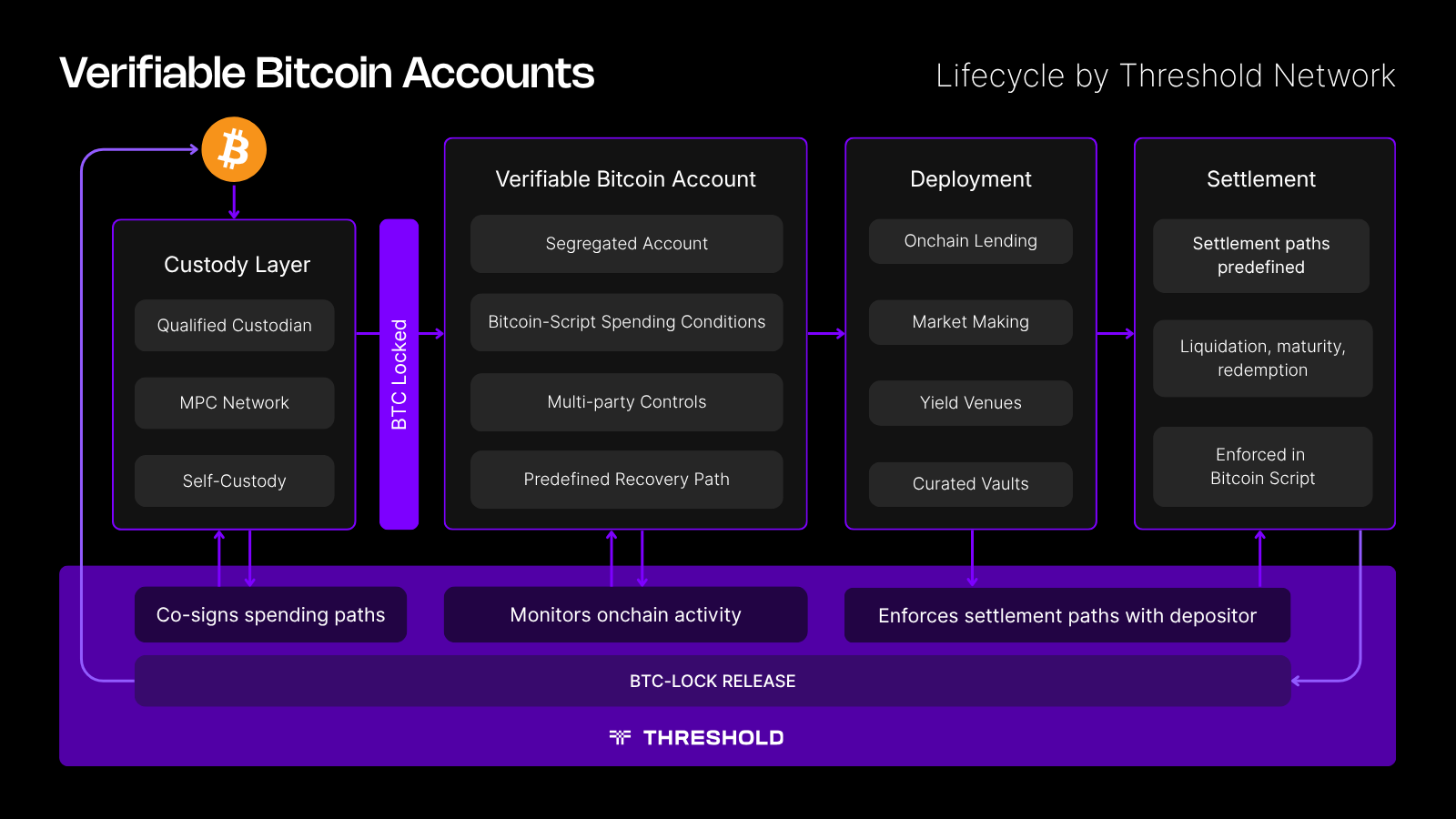
- Your Bitcoin, Your Custody. BTC remains with the institution's existing qualified custodian. For institutions that have spent months or years establishing custody arrangements, this removes the largest single barrier to on-chain deployment. Every movement is constrained, auditable, and aligned with existing institutional compliance requirements.
- Spending conditions are written in Bitcoin Script. Multi-party controls and recovery paths are encoded as PSBT-based (BIP-174) Bitcoin transactions and enforced by Bitcoin consensus itself. As Threshold Co-Founder MacLane Wilkison put it, the design replaces "additional layers of trust" with "outcomes that are defined, enforceable, and verifiable from the outset."
- Pre-defined Recovery paths. If the signer network stalls, the depositor and custodian recover BTC directly. There is no external oracle and no off-chain dependency in the liquidation flow, which is the operational requirement that determines whether BTC can scale as collateral.
- Real Bitcoin Yield. Yield is sourced from productive Bitcoin usage, not incentive token emissions. A structured spectrum of fixed and variable rate products from 2% to 12%, designed for institutions that require transparency at every layer of the return stack.
The economic case is what makes this urgent now. With Bitcoin-backed lending heading past $90B in 2026 and stablecoin liquidity heading past $1T, the institutions on the sidelines are not waiting for yield; they are waiting for a deployment model that respects their frameworks.
If you are an institution or institutional allocator looking for DeFi for Bitcoin, the entry point is Verifiable Bitcoin Accounts. Talk to Threshold's institutional coverage team to start your onboarding process.
Where to Use Bitcoin as Collateral: tBTC Lending Markets
Once you hold tBTC, you can now explore multiple decentralized financing strategies, instead of letting your Bitcoin sit idle. Because tBTC is a fully decentralized, ERC-20-compatible asset, it can be seamlessly plugged into decentralized lending markets. This opens up two primary financial strategies: borrowing stablecoins against your tBTC to extract liquidity without selling your Bitcoin, or borrowing tBTC itself to short the asset or deploy it into advanced yield-farming strategies.
The decentralized lending landscape for tBTC spans multiple chains, each offering different advantages depending on your gas tolerance and preferred ecosystem.
Blue-Chip Money Markets
For deep liquidity and battle-tested security parameters, the major money markets are the primary venues for tBTC.
- Aave (v3): As the largest non-custodial liquidity protocol in DeFi, it lists tBTC as a reserve asset on the Ethereum Mainnet. The tBTC reserve currently holds approximately $148M in supplied liquidity, against a governance-set supply cap of 3,000 tBTC.
- Strategy: Supply tBTC to the Aave v3 Ethereum reserve to (a) earn passive supply APY on the deposit, and (b) use the position as collateral to borrow stablecoins (USDC, USDT, GHO) or ETH against your BTC. Borrowed liquidity can be deployed into higher-yielding venues, recycled into additional BTC exposure (looped long), or held as operating liquidity while retaining upside on the underlying tBTC.
- Yield characteristics: Supply APY on tBTC is structurally low because borrow demand for BTC wrappers on Aave remains limited, most depositors use tBTC as collateral rather than borrow it, which keeps utilization and therefore supply rates compressed. The position is best understood as collateral with modest passive yield, not a primary income strategy. Unlike Compound v3, where collateral assets earn nothing, Aave does accrue interest on supplied tBTC, even if the rate is low.

- Compound (v3): Compound v3 uses a one-base-asset-per-market architecture. Each deployment supports a single borrowable asset (USDC, ETH, USDT, or USDS) and a curated set of collateral assets that can be posted but not supplied for yield. tBTC is whitelisted as a collateral asset in the USDC market on Ethereum, with approximately $4.4M currently posted.
- Strategy: Post tBTC as collateral in the USDC Comet to borrow USDC against your BTC position. Use the borrowed USDC for Stablecoin yield strategies, additional BTC exposure, or operating liquidity, while retaining upside on the underlying tBTC.
- Important architectural note: Unlike Aave, Compound v3 does not pay supply interest on collateral assets. tBTC posted to Comet earns zero yield on its own; it functions purely as borrowing collateral. The base asset (USDC) is the only side of the market that accrues supply interest. This makes Compound v3 a borrowing venue for tBTC holders, not a passive yield destination.
Hyper-Efficient & Modular Markets
If you are optimizing for precise risk management or isolated risk profiles, modular protocols offer highly tailored tBTC pools.
- Morpho: Morpho is a permissionless lending protocol structured as isolated, immutable markets each defined by a single collateral asset, loan asset, oracle, interest rate model, and liquidation LTV. The tBTC/USDC market on Ethereum currently holds approximately $2.3M in supplied liquidity.
- The Strategy: Post tBTC as collateral to borrow USDC, retaining long BTC exposure while accessing dollar liquidity.
Case study: Abra's institutional lending migration
The clearest signal that tBTC has become production-grade collateral comes from the institutions moving their books onto it. In June 2026, Abra, a digital asset wealth and treasury management platform serving high-net-worth individuals and institutions, shifted from wBTC to tBTC as the primary on-chain Bitcoin collateral for its lending platform. For a platform with fiduciary obligations, the deciding factors were on-chain verifiability, permissionless design, lower cost, and a faster redemption route back to native Bitcoin.
The full breakdown is documented in Abra's collateral architecture case study, which is worth reading if you are evaluating tBTC as a collateral standard for a lending book of your own.
Where to lend Bitcoin and earn on supply
The venues above are built primarily for borrowing against Bitcoin. If your goal is the opposite, lending your Bitcoin out to earn on the supply side, the money-market supply leg is only a starting point, since supply APY on tBTC there stays compressed for the reasons described above. The more productive route for supply-side Bitcoin yield is the managed vault, where deposited tBTC is routed into structured strategies rather than sitting in a lending reserve.
Bitcoin Yield Vaults on tBTC
Single-asset tBTC vaults are the cleanest yield exposure: deposit tBTC, hold a receipt token, do nothing. The trade-off is that APYs are typically lower than LP pools because there is no impermanent-loss risk to compensate for. Below are the live vaults from a 2026-05-25 snapshot (DefiLlama Yields API, plus Threshold launch disclosures), sorted by TVL.
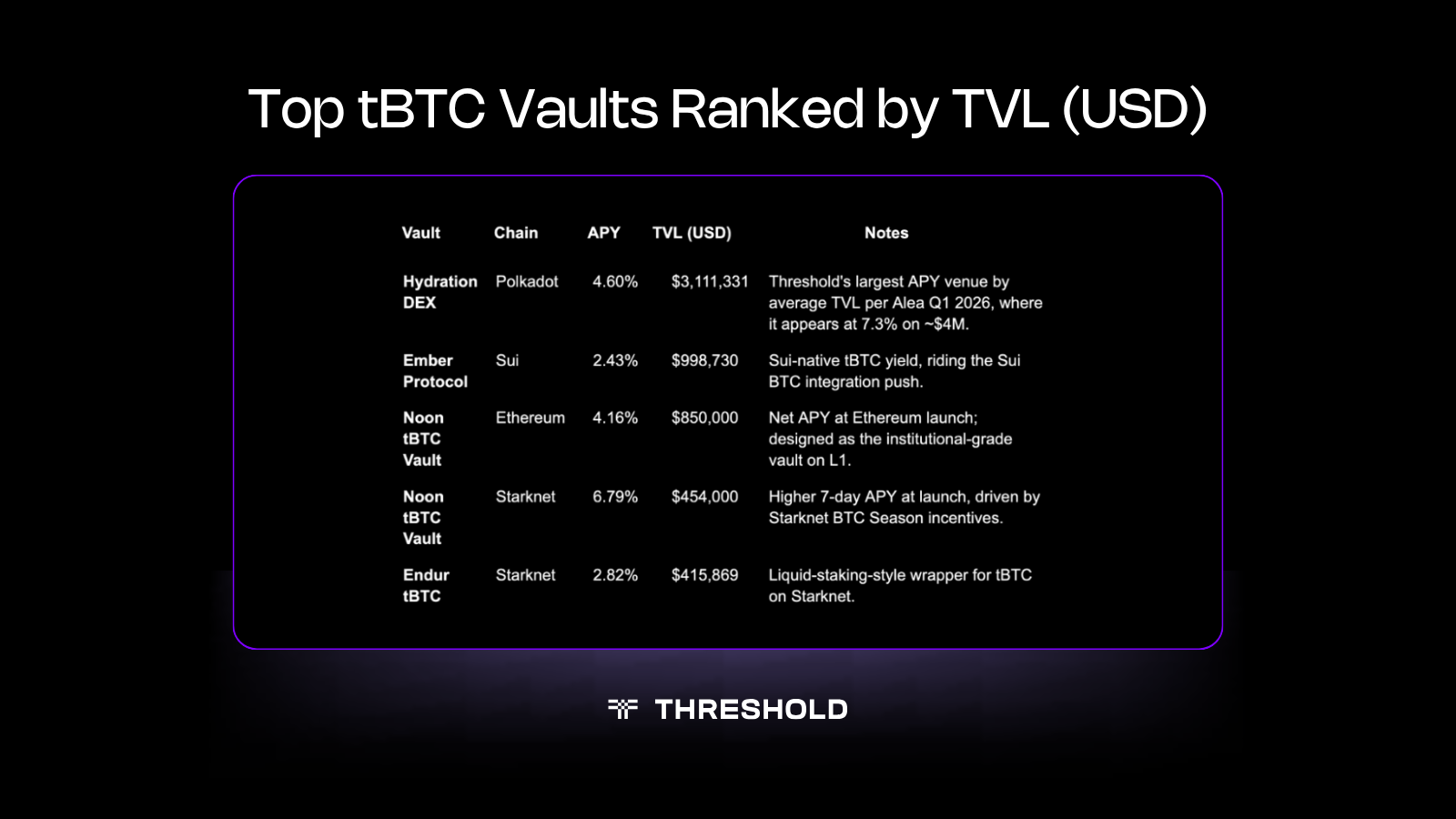
The lending markets (Aave v3, Compound v3, Morpho Blue) all show 0% supply APY in the same snapshot, with combined deposits of ~$157M on Aave alone. tBTC has become deep collateral on the largest decentralized money market, even when the supply leg pays nothing.
Where to Earn Bitcoin Yield in Liquidity Pools
Where yield is concerned, TVL depth is usually more durable than headline APY. The aggressive 25%+ APYs at the top of the DefiLlama list are reward-token emissions on small pools that will compress as liquidity arrives. Real institutional Bitcoin capacity sits in the pools below, sorted here by TVL, with APY shown:
.png)
Note: On May 12, 2026, the existing tBTC/WBTC pool on Ekubo migrated into a new strkBTC/tBTC pair.
For the old Ekubo pair (wBTC-tBTC) the 5% APY incentive carries over to the new tBTC/strkBTC, and stablecoin loan incentives against tBTC are unaffected. Existing tBTC/wBTC LPs will receive 50% incentives for one month before the pool sunsets.
Incentives and liquidity that had been pooled in tBTC/WBTC were aligned to the new strkBTC/tBTC pair. For LPs, that converts the pool from "another BTC-BTC pair" into the primary on-ramp between public and private Bitcoin liquidity on Starknet, a position other wrapper pairs cannot occupy without a comparable trust model.
The Era of Capital-Efficient Bitcoin
The structural landscape of Bitcoin has fundamentally shifted. The emergence of tBTC and Verifiable Bitcoin Accounts (VBAs) effectively dismantles the old compromise between security and yield. You no longer have to choose between the counterparty risks of centralized custodians or the systemic vulnerabilities of multi-asset liquidity pools.
The gateways have been built; the money markets have integrated. Bitcoin can no longer sit still and hold passive value. In 2026, it is the ultimate sovereign collateral, ready to be deployed. Stepping through these doors of opportunity is entirely up to you.
Sources & References
Primary research and data:
- Threshold Q1 2026 Benchmark Report by Alea Research: The Proven Standard for Decentralized Bitcoin
- Galaxy Research — The State of Crypto Leverage, Q3 2025
- EY-Parthenon × Coinbase 2025 Institutional Investor Digital Assets Survey (PDF)
- DefiLlama Yields API
Threshold Network primary sources:
- Verifiable Bitcoin Accounts: institutional Bitcoin DeFi framework
- tBTC v2 technical documentation
- Threshold Network institutional landing page
- BTCFi Season on Starknet with tBTC
News and ecosystem coverage:
- Cointelegraph: Threshold improves tBTC bridge for institutional BTC DeFi
- CoinDesk: Bitcoin-backed lending market could hit $1T (Ledn / Protocol Theory)
- Starknet Foundation: strkBTC is live — private Bitcoin arrives on Starknet
- The new strkBTC-tBTC pool on Ekubo (tBTC_project announcement)
- Starknet 2025 Year in Review
- eMarketer: Stablecoin Explainer 2026
Discover all tBTC yield and DeFi opportunities on the Threshold App.
.png)
.png)