Bitcoin entered the second half of 2026 in a defensive posture. Through July, BTC traded in the low-to-mid 60K, well below its October 2025 high near 126K, and spot Bitcoin exchange-traded funds recorded their heaviest monthly outflows on record in June. The way holders and allocators think about putting tokenized bitcoin to work onchain has changed in this new market context. The priority has moved toward verifiable custody and a dependable route back to native Bitcoin, rather than reach across chains for its own sake.
Cross-chain reach holds its value only when the underlying custody is decentralized and redemption is guaranteed, and tBTC's architecture is built for that condition.
The 2026 Reset in Bitcoin DeFi
.png)
Bitcoin DeFi contracted sharply in 2026. By mid-year, Spark research placed layer-2-tracked BTCfi (Bitcoin deployed across Rootstock, Stacks, and other Bitcoin-adjacent execution environments) at approximately 91,000 BTC, roughly 0.46% of Bitcoin's 20.05M circulating supply, after a steep drawdown from 2025 highs.
The contraction was uneven in its causes. A run of wrapping and bridging incidents through the year, including a double-minting exploit at a liquid staking token issuer, hardened a view Bitcoin-native holders had been forming for some time: moving BTC into other environments introduces risk that access alone does not justify.
Capital rotated toward models that keep Bitcoin closer to its base layer, particularly native staking approaches where BTC never leaves the holder's control, or using bridges like tBTC that offers decentralized BTC bridging, while the core BTC remains to its base layer - Bitcoin Network. The deciding variable became the strength of the custody model, not the depth of any single liquidity pool.
Six events across 22 months restructured the market:
- September 12, 2024 — Coinbase launches cbBTC on Ethereum and Base under Coinbase Custody, adding a second scaled custodial issuer.
- October 2024 — BitGo transitions WBTC to a tri-key custody arrangement across BitGo US, BitGo Singapore, and BiT Global Hong Kong.
- November 2024 — Sky (formerly MakerDAO) ratifies full WBTC offboarding at 88.17% support and completes a five-phase wind-down of approximately $200M in exposure by month-end.
- April 23, 2026 — Threshold launches Verifiable Bitcoin Accounts, the first non-custodial framework for institutional BTC deployment through existing qualified custodians.
- June 8, 2026 — Circle launches cirBTC on Ethereum under Circle International Bermuda Limited, adding a second regulated custodial issuer to the market.
- June 9, 2026 — Botanix announces a full wind-down after 11 months of mainnet, citing demand-side reasons rather than technical failure.
The consecutive-day sequence of the cirBTC launch and the Botanix wind-down was not a coincidence of the calendar. It is the reset in miniature. On one day, the market absorbed a second regulated custodial wrapped BTC. On the next, it retired one of the most-funded attempts to build Bitcoin-native L2 execution. Read together, this is a market restructuring event, not a downturn.
Before the reset
Wrapped Bitcoin was an Ethereum-only story. WBTC held roughly 92% of the wrapped BTC market as of August 2024. Ethereum was the only meaningful destination for on-chain Bitcoin liquidity. Bitcoin L2 alternatives (Rootstock, Stacks) sat two orders of magnitude below wrapped BTC on Ethereum by deployed capital.
After the reset
Tokenized Bitcoin fragmented across chains. Ethereum remains the largest venue but no longer holds a monopoly. Base is dominated by cbBTC, which anchors most of Coinbase's $5.4B in total cbBTC supply across chains. Solana sees tBTC and cbBTC in active competition. Mantle is concentrated in FBTC at approximately $1.5B. tBTC deploys with the same trust-minimized model across Ethereum, Arbitrum, Solana, Base, and Starknet, and is the only wrapped BTC that carries a uniform custody model on every chain.
.png)
What Chain-Agnostic Tokenized Bitcoin Means
Tokenized Bitcoin (or BTC Wrappers) is a Bitcoin-backed asset issued on another blockchain and redeemable for native BTC. It exists because Bitcoin's base layer was not designed to support the smart contract execution most DeFi applications require, and because the capital that wants to use Bitcoin on-chain has moved to environments where that execution is native.
Chain-agnostic tokenized Bitcoin describes a further property: a single Bitcoin-backed asset with a unified reserve and a consistent trust model across every chain it reaches, with the movement mechanics kept out of the holder's way. The holder interacts with one asset, not a separate wrapped version per network. Chain-agnostic tokenized Bitcoin is what chain abstraction looks like when the asset in question is Bitcoin.
Two adjacent terms are worth separating.
- Chain abstraction. The design goal of hiding chain selection and gas requirements from the user. A UX and infrastructure objective, not an asset property.
- Interoperability. The underlying transfer of assets and data between networks. The plumbing that makes chain abstraction possible.
Chain-agnostic tokenized Bitcoin sits on top of interoperability and delivers chain abstraction for one specific asset class.
tBTC in the chain-agnostic era
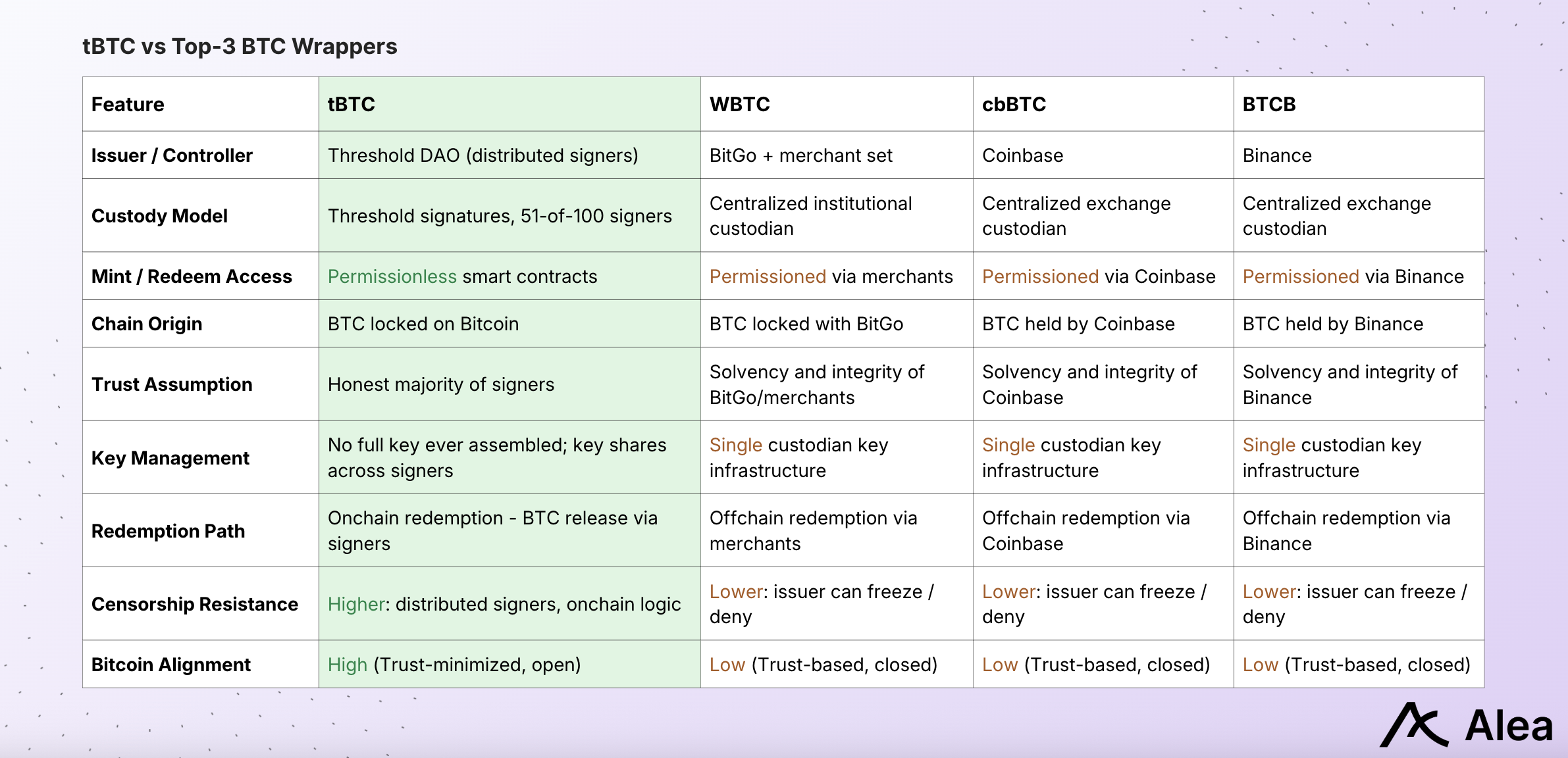
tBTC is the only wrapped Bitcoin that carries the same trust-minimized custody model on every chain it deploys on. Ethereum, Arbitrum, Base, Solana, Starknet. Same 51-of-100 threshold signer set. Same permissionless mint and burn. Same 1:1 redemption path to native Bitcoin from any chain of issuance.
Operating record: $5B in cumulative bridge volume across six years of mainnet operation. Zero losses.
Why Custody Model Matters
Reach across chains multiplies whatever trust assumption sits beneath the asset. When the underlying Bitcoin depends on a single custodian, every additional chain extends that same point of dependence further across the market. The tokenized Bitcoin market splits into two custody models.
- Custodian-held. A company holds the underlying Bitcoin and issues the token against it.
- Decentralized. The underlying is secured by a distributed system where no single party can move it alone.
A guaranteed, permissionless path back to native Bitcoin lets a holder exit regardless of conditions on any given chain. Most custodian-held models route redemption through authorized participants rather than the end holder, which leaves a secondary-market swap as the practical exit.
How tBTC is Keeping the BTCFi Momentum
Decentralized custody
tBTC replaces a single custodian with a threshold-signing model. A quorum of independent nodes secures deposited Bitcoin, and a threshold majority of 51-of-100 must agree before any action on the underlying can occur. The operator set rotates on a fixed cadence, so no static group ever holds control long enough to coordinate against the deposits.
Canonical Multi-chain Supply
The multi-chain design uses a canonical-token model. tBTC is minted on Ethereum. When it moves to another network, the Ethereum-side tBTC is locked and a canonical token is deployed on the destination chain. Total supply stays intact, and each ecosystem carries its own contained risk. One supply backs every deployment, in place of a distinct wrapped token per chain.
This is the structural answer to fragmentation.
Movement without the friction
Minting is a single Bitcoin transaction into a chosen chain, with a direct path back to native Bitcoin on redemption. The Unified Bitcoin Router brings minting, redemption, and cross-chain movement onto one surface. tBTC is now live across multiple networks:
- EVM and EVM-compatible. Ethereum, Arbitrum, Base, Starknet
- Non-EVM networks: Solana, and Sui
Distribution is concentrated on Ethereum today, with cross-chain adoption in its early phase. The rails are live across [N] networks and usage continues to grow, as documented in the tBTC 2025 Review.
What This Means for Institutions
Institutional demand for Bitcoin-backed onchain activity has grown alongside the wider onchain credit market. The Verifiable Bitcoin Accounts announcement cited a projection for institutional Bitcoin lending near $90 billion by the end of 2026, set against a stablecoin market that passed $308 billion early in the year.
Verifiable Bitcoin Accounts is an account framework built on Bitcoin Script and the Partially Signed Bitcoin Transaction standard. The institution's Bitcoin remains in its existing custody arrangement in a segregated account, and spending conditions and recovery paths are written in Bitcoin Script and enforced by Bitcoin consensus. The design keeps verification, in place of added intermediaries, at the center of how capital is deployed.
The direction of adoption shows up in specific migrations. Threshold has reported Abra moving its lending from wBTC to tBTC, with associated growth in onchain deployment, as allocators look for Bitcoin collateral whose backing they can verify directly.
Tokenized Bitcoin Projection
The through-line of 2026 is a market pricing custody and redemption more carefully than reach. Here are three outlooks to consider:
- Whether the custodial tier absorbs a governance event of its own. The 2024 BitGo and BiT Global transition took roughly 36 share points from WBTC in 22 months. A comparable event on cbBTC or cirBTC would reroute capital identically.
- Whether chain-agnostic presence becomes a property of one trust-minimized asset or remains a fragmented set of chain-specific wrappers. tBTC is the only wrapped BTC that keeps the same trust model across Ethereum, Arbitrum, Base, Solana, and Starknet. FBTC, LBTC, and the custodial tier do not.
- Direction of travel. Chain-agnostic presence, built on one trust-minimized foundation with a guaranteed exit to native Bitcoin, is the design that survives the repricing. Whether the wider category consolidates around that model depends on how quickly institutional adoption tests the alternatives.
To see how tBTC moves across chains and returns to native Bitcoin, read the tBTC documentation.
Sources
1. Bitcoin price in July 2026 and market capitalization. Fortune daily Bitcoin price page
2. Record Bitcoin ETF outflows in June 2026. 24/7 Wall St.
3. BTCfi total value locked contraction and share of Bitcoin supply deployed onchain by Spark research.
4. Wrapped Bitcoin market capitalization and Ethereum - CoinStats fundamental analysis and Coin Bureau.
5. tBTC track record, The Block, via Threshold Network announcement.
6. Canonical-token model description. Threshold documentation, L2TBTC.
Learn more about Institutional Bitcoin Deployment
.png)