.png)
Bitcoin's move onchain gained ground through July, with tBTC deposits on Aave V3 climbing past 2,000 on Ethereum and structured strategies expanding across networks. The month's work centered on giving Bitcoin holders verifiable paths to deploy BTC while keeping native custody.
Through July, Threshold brought the tBTC vaults dashboard online across three networks. Deposits into tBTC on Aave V3 held above 2,000 on Ethereum, with Bitcoin serving as the reference collateral for onchain credit. tBTC's supply continued to track organic mint and redemption, reflecting demand that forms without incentive programs. That organic base reinforces tBTC's standing as a trust-minimized route for Bitcoin liquidity across the multichain ecosystem.
Highlights
- tBTC deposits on Aave V3 Ethereum crossed 2,000 tBTC in July, with the 60-day view climbing from its early June base and Bitcoin holding as the reference collateral for onchain credit.
- Threshold published an analysis on custody model and institutional Bitcoin, setting out why verifiable custody positions tBTC for the next stage of onchain deployment.
- Threshold surfaced the four tBTC vaults currently active across three networks, holding $24.6M in combined total value locked.
- Threshold mapped three core Bitcoin use cases, from retail to institutional markets.
- A capital structure case study quantified tokenized Bitcoin's lead over Bitcoin Layer-2s, at $12.87B against $223.5M.
Milestones
tBTC Deposits on Aave V3 Cross 2,000 on Ethereum
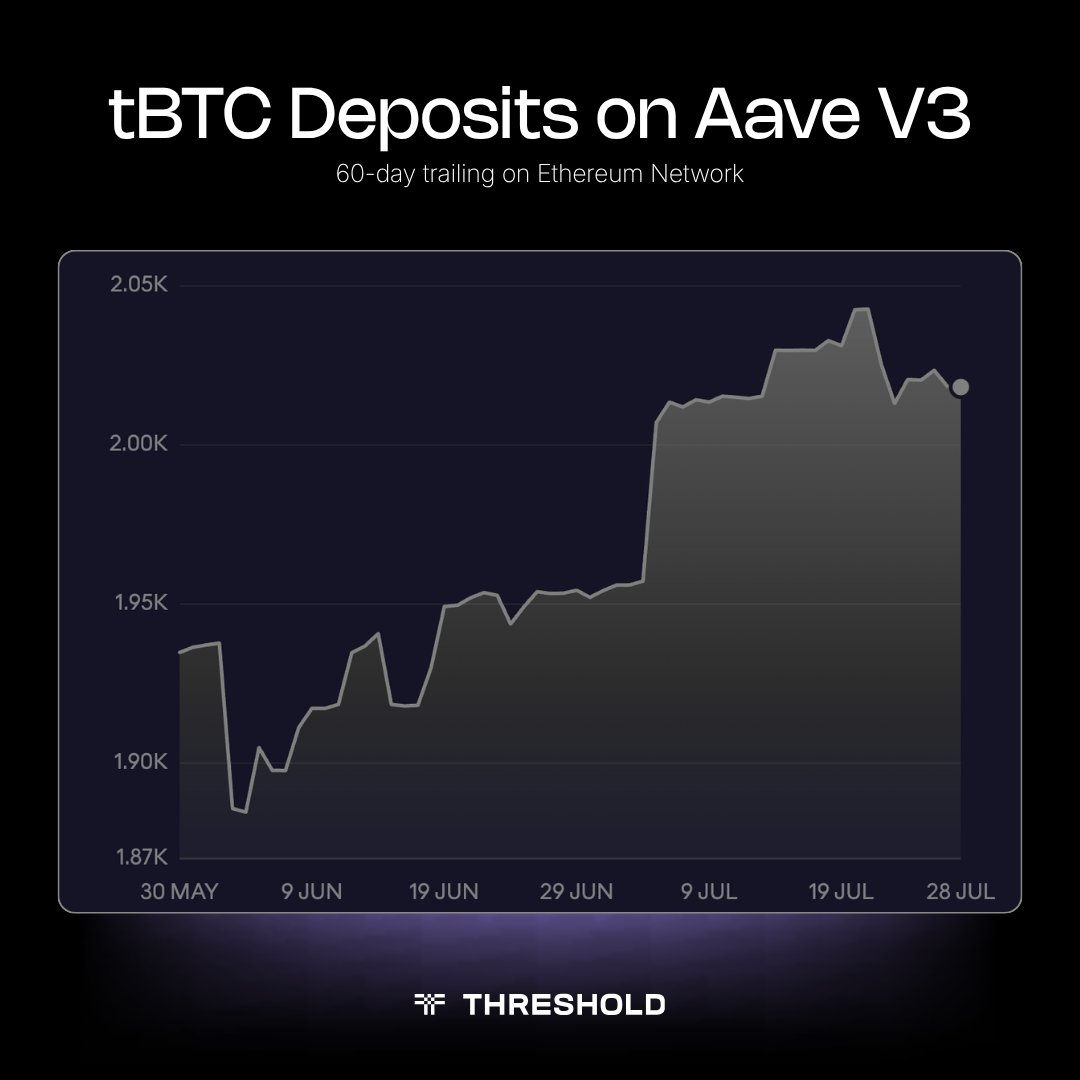
tBTC deposits into Aave V3 on Ethereum moved past 2,000 tBTC during July, with the 60-day trailing view rising from an early June base near 1,900. The climb held through the back half of the month and settled just above the 2,000 mark.
Aave remains one of the primary venues where Bitcoin functions as reference collateral for onchain credit. Deposits at this level indicate that holders are treating tBTC as a working position within lending markets, keeping Bitcoin productive while retaining native custody.
Six Years on Mainnet and $5B in Cumulative Bridge Volume
tBTC passed its sixth year of continuous mainnet operation in 2026, with cumulative bridge volume reaching $5 billion over that span. This track record sits behind Threshold's position that threshold cryptography remains the most viable permissionless route for moving Bitcoin onchain.
The Why Threshold Cryptography Matters analysis traced that maturity from Shamir's 1979 work through to NIST standardization, connecting decades of research to the signing model that secures tBTC today. Six years of operation gives institutions a measurable basis for evaluating decentralized custody against single-signer alternatives.
Organic Demand Holds at 32% Year Over Year
At the DeFi at Maturity panel, Threshold Labs co-founder Callan Sarre pointed to demand that arrives without subsidy, with roughly 70% of tBTC supply deployed across DeFi and a 32% year-over-year increase in that activity. Liquidity that forms without incentive programs tends to hold through capital rotations.
That organic profile is what institutions weigh when they assess whether a Bitcoin position will stay liquid over time. tBTC's supply moved with genuine mint and redemption rather than reward-driven inflows, giving that demand a durable base.
Ecosystem Growth
Four Active tBTC Vaults for Onchain Deployment
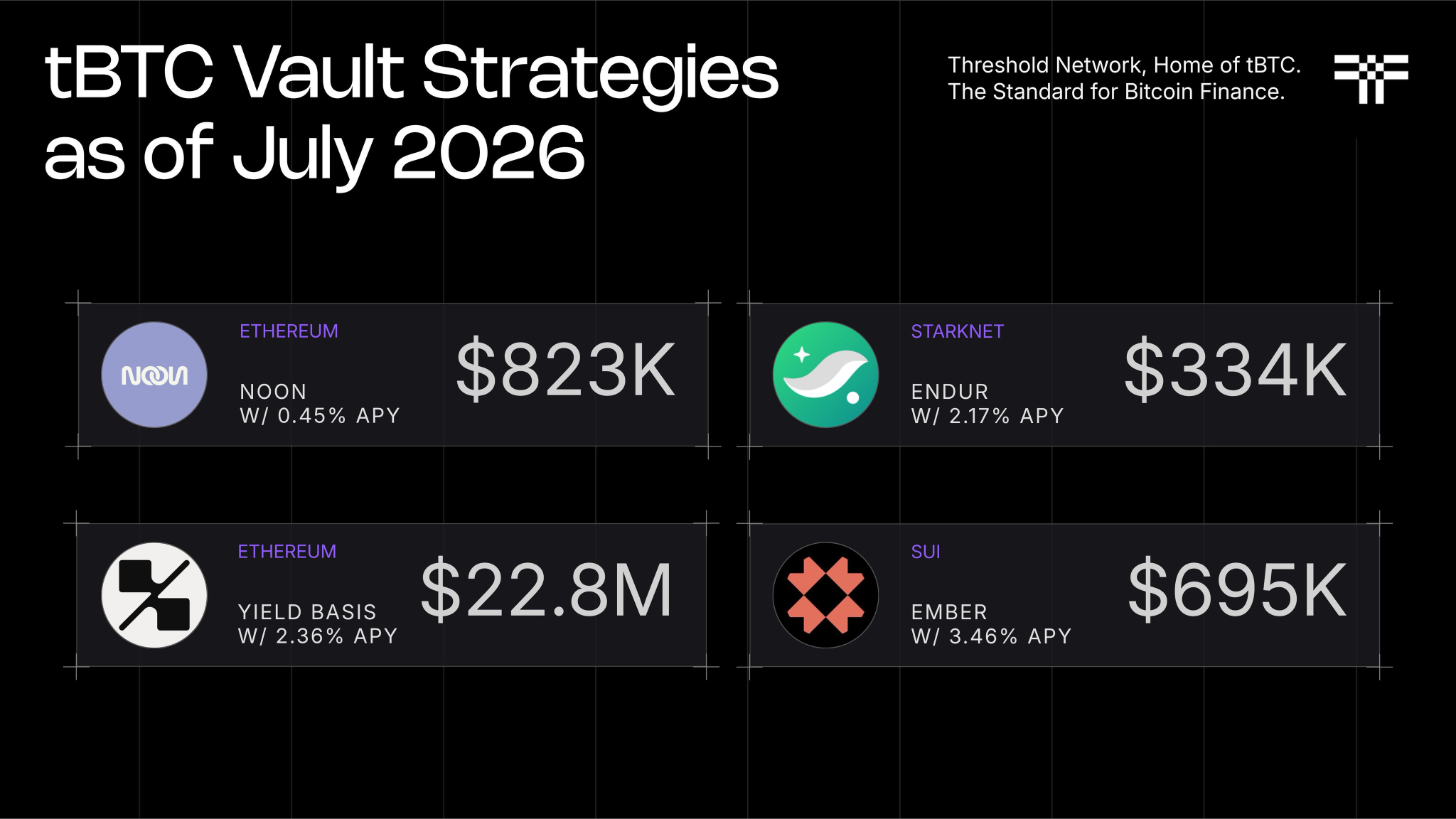
The tBTC vaults dashboard brings the currently active vault strategies into a single view, covering four vaults across Ethereum, Starknet, and Sui that are ready for onchain Bitcoin deployment. Combined total value locked reached $24.6M, which represents 7.8% of all tBTC in circulation and close to 13% of its DeFi-deployed value.
Yield Basis on Ethereum leads the set at $22.8M in total value locked, with the Noon vault on Ethereum, Endur on Starknet, and Ember on Sui completing the roster. Each vault applies its own strategy while holding tBTC as the underlying Bitcoin collateral, extending how holders route Bitcoin into productive positions across chains.
tBTC on Base Holds a Stable Supply Floor
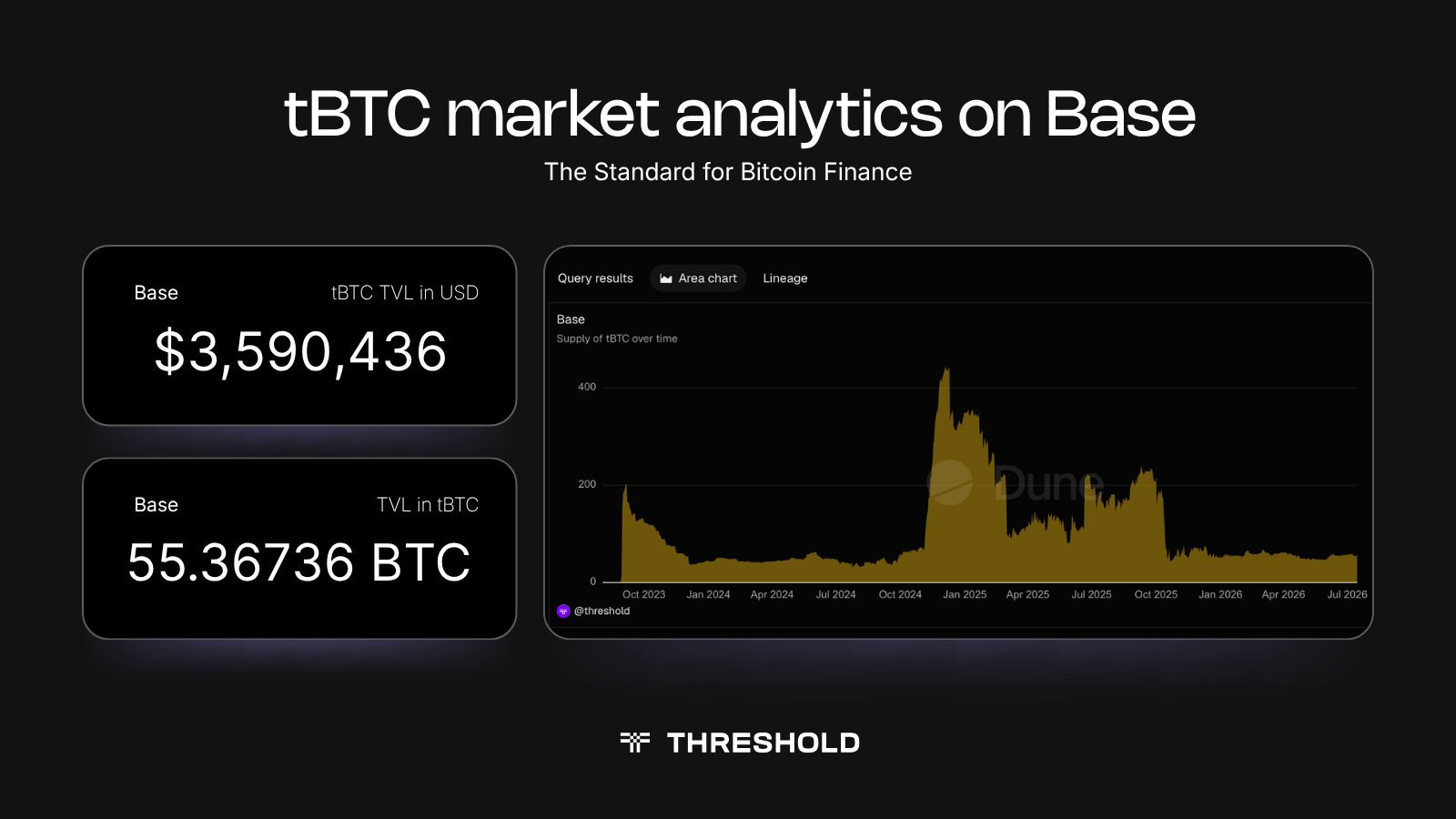
tBTC on Base carried about $3.59M in Bitcoin backing through July, equal to roughly 55 BTC on the network. Since December, that supply has held between 48 and 61 BTC, a floor that has stayed level for more than half a year.
Because tBTC is minted and burned permissionlessly against real Bitcoin, its supply on any chain reflects genuine demand rather than bridged or incentivized balances. A stable floor on Base over six months points to a resident base of holders using tBTC as working Bitcoin within that ecosystem.
tBTC as Collateral Across Lending Venues
Holders can access stablecoin liquidity against tBTC as collateral while keeping their underlying Bitcoin. Coverage spans Aave across Ethereum, Arbitrum, and Base, with additional venues on Ethereum through Morpho, Curve, and Asymmetry.
This breadth gives Bitcoin holders multiple routes to borrow against their position while retaining native exposure. Each venue draws on different stablecoin liquidity, from major issuers on Aave through to protocol-native units on Curve and Asymmetry.
Looking Ahead
July showed that tBTC remains a core BTCFI asset, with tBTC deposits crossing 2,000 on Aave, a 32% year-over-year rise in DeFi activity, and a Base supply floor steady for more than half a year. Verifiable Bitcoin Accounts carry that same standard to institutions, letting qualified custodians to use BTC onchain while every transaction stays verifiable on Bitcoin Script, and with the share of Bitcoin active in DeFi still well below that of ETH, the headroom ahead is substantial. Backed by six years of trust-minimized operation and $5 billion in cumulative bridge volume, Threshold continues to widen the venues and strategies where tBTC serves as the standard for Bitcoin finance.
Follow for upcoming updates and releases, and explore onchain Bitcoin deployment through the Threshold App.
.png)