
Threshold cryptography is old enough that its foundational paper predates the personal computer's mainstream arrival. The state of BTCFi in 2026 shows that the failures it was designed to prevent keep recurring, and institutional Bitcoin capital is deploying onchain through infrastructure that depends on it.
There is also a distinction worth stating plainly. Many companies borrow threshold mathematics inside proprietary custody products. Only one public, decentralized network is built on threshold cryptography end to end, from its signing infrastructure to its governance to its name: Threshold Network, and its six-year production record is the strongest available evidence for why the technique still matters.
The Architecture
Threshold cryptography is a method of performing cryptographic operations, such as signing or decryption, across a group of independent parties so that no single participant ever holds the complete private key. An operation succeeds only when a predefined minimum number of participants, the threshold, cooperate. The result is a system with no single point of failure and no single point of trust, which will be further explained in the following section.
The foundation is Adi Shamir's 1979 paper "How to Share a Secret," published in Communications of the ACM, which showed how to divide a secret into n pieces such that any k reconstruct it perfectly while any k minus 1 reveal nothing at all. In a modern Threshold Signature Scheme (TSS), a distributed group generates key shares and produces signatures jointly, and no individual signer ever holds the complete key.
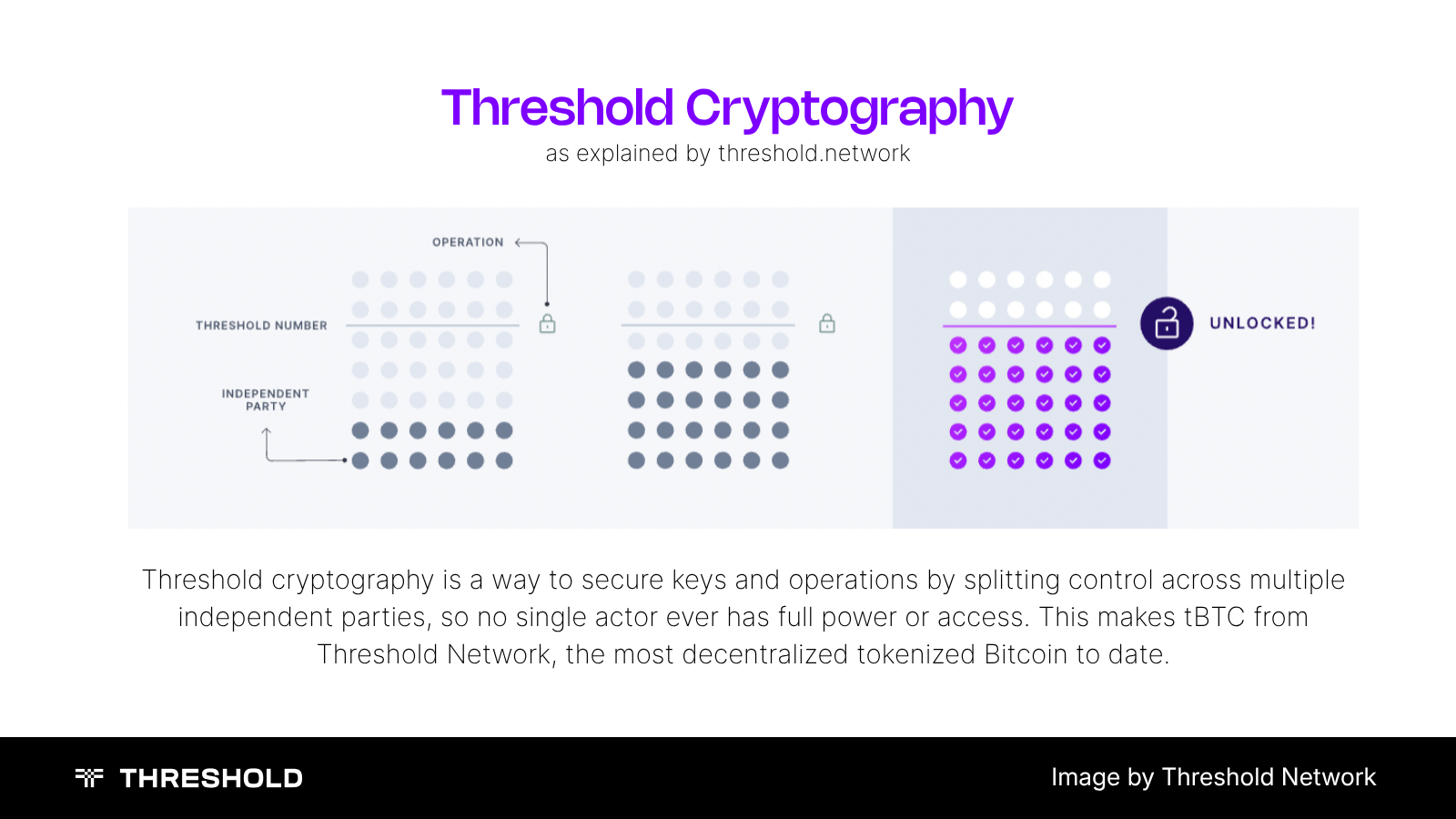
A ten-node cluster with the threshold at seven illustrates the properties:
- At least seven participants must execute the protocol together for an operation to succeed
- Participants never reveal their shares to one another
- The protocol produces a valid result while every share stays private
- Any six or fewer participants, cooperating or compromised, can neither perform the operation nor learn anything about the key
Why It Still Matters Today
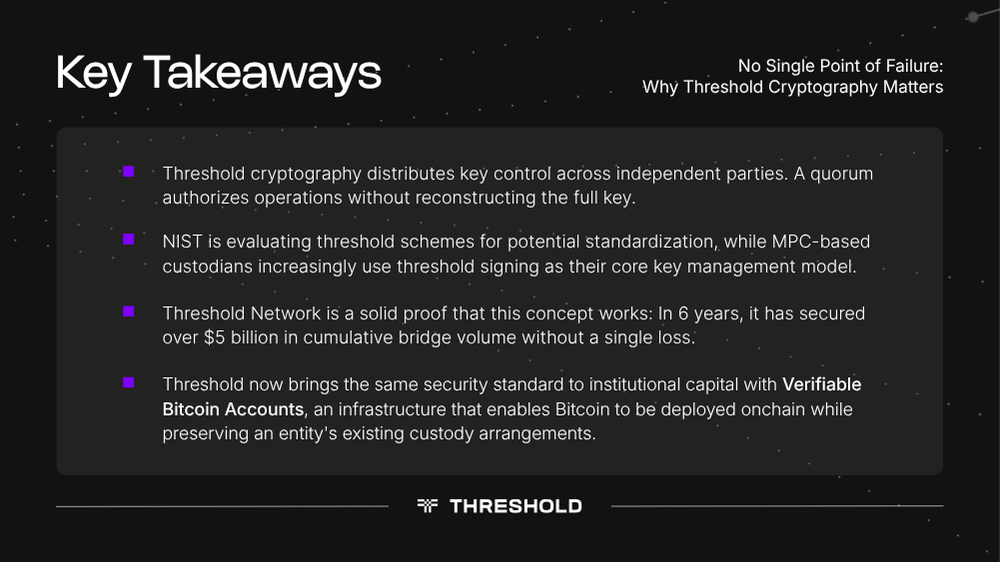
The case for threshold cryptography rests on a failure mode that the industry has not engineered away: concentrated control of a private key. A single keyholder is a single point of compromise, a single point of coercion, and a single target whose failure is total.
The relevance in 2026 is institutional: More than 2,000 institutional investors disclosed Bitcoin ETF positions in their Q1 2026 filings even as aggregate professional holdings fell through the drawdown, and CoinShares' analysis of those filings found the selling concentrated among hedge funds and brokerages, while banks, governments, family offices, and insurance investors each added net exposure. U.S. spot ETFs still hold roughly 1.3 million BTC, more than 6% of the total supply. The cohorts that stayed and accumulated are the long-duration allocators, and capital of that character cannot accept key arrangements that depend on any single party behaving well. Fiduciary mandates exist precisely to screen out that dependence, which makes the technique that removes unilateral key control more load-bearing today than at any point since its invention.
The threshold property answers the failure mode directly:
- No single point of failure. If a participant loses key material or goes offline, the protocol continues as long as the threshold remains reachable
- No single point of trust. No operator can act unilaterally, whether through malice or coercion
- Collusion resistance. An attack must reach the threshold itself, so a properly parameterized system turns an attack requirement into a supermajority requirement
- Operational continuity. No individual can create a bottleneck, which is what allows threshold systems to run continuously in adversarial, high-value environment.
The Standardization Signal
Obsolete techniques do not get standards tracks. NIST's Multi-Party Threshold Cryptography (MPTC) project applies principles of secure multi-party computation to achieve a secure distribution of trust in the operation of cryptographic primitives, and the project is now in an active submission phase:
- NIST IR 8214C, the First Call for Multi-Party Threshold Schemes, solicits public submissions covering signatures, encryption and decryption, key generation, and related building blocks such as zero-knowledge proofs
- The MPTS 2026 workshop, held in January 2026, gathered dozens of preview submissions from research teams worldwide, with further talks scheduled through mid-2026
This is the same process that produced AES and SHA. A technique entering that pipeline in 2026 is not a historical curiosity. It is the reference cryptography of the next decade being written in real time, and systems already built on threshold signing are ahead of the standard.
What Six Years in Production Proves
Threshold signatures have become common inside enterprise custody. MPC-based custody platforms serving financial institutions use distributed key generation and threshold signing as their baseline security model. That adoption validates the mathematics, and it also has a structural limit: in this institutional deployment, the key shares typically live inside one vendor's infrastructure, under one company's operational control and one company's continuity risk. The math is distributed while the trust, in practice, is not.
Arguments for a cryptographic technique are ultimately settled by operating history. Threshold Network's numbers:
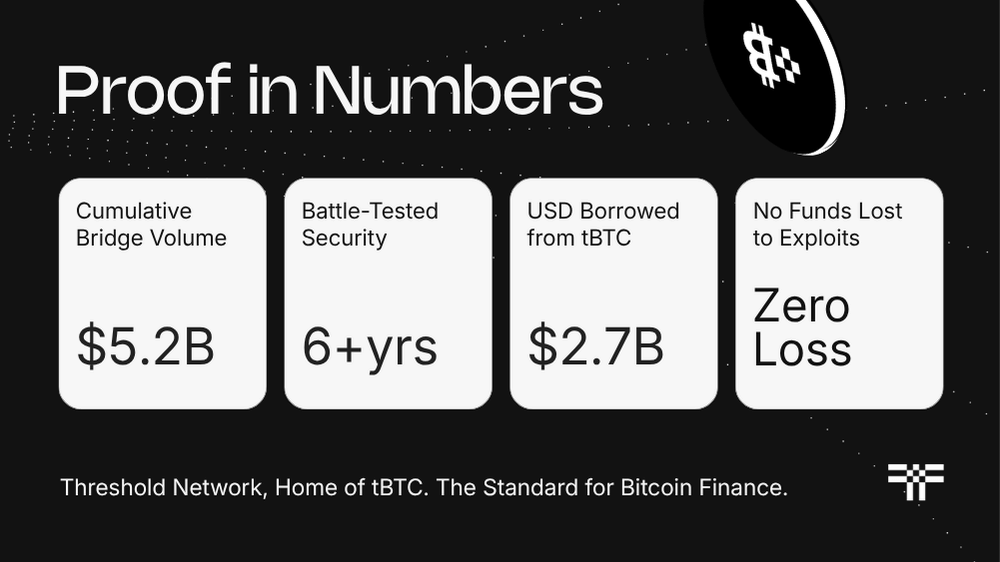
The record compounds in 2026, and it holds up in the terms institutions actually use during a drawdown. Abra migrated its lending operations to tBTC as collateral, part of a broader pattern of allocators selecting Bitcoin collateral they can verify onchain rather than trust by attestation. Alea Research's Q1 2026 benchmark report shows tBTC supply ended Q1 up 32% YoY, and DeFi deployment rose 19% QoQ in BTC terms to roughly 7,000 BTC even as dollar values fell.
Where It Matters Most Now: Institutional Bitcoin Onchain
The clearest answer to why threshold cryptography still matters is Verifiable Bitcoin Accounts (VBA), announced in April 2026 as Threshold's flagship product. VBA applies the threshold property to the specific problem blocking institutional onchain deployment: fiduciaries cannot accept counterparty exposure they are unable to independently verify.
A Verifiable Bitcoin Account defines preauthorized spending paths, signer combinations, security time-locks, and recovery routes at setup, enforced at the Bitcoin level through five components:
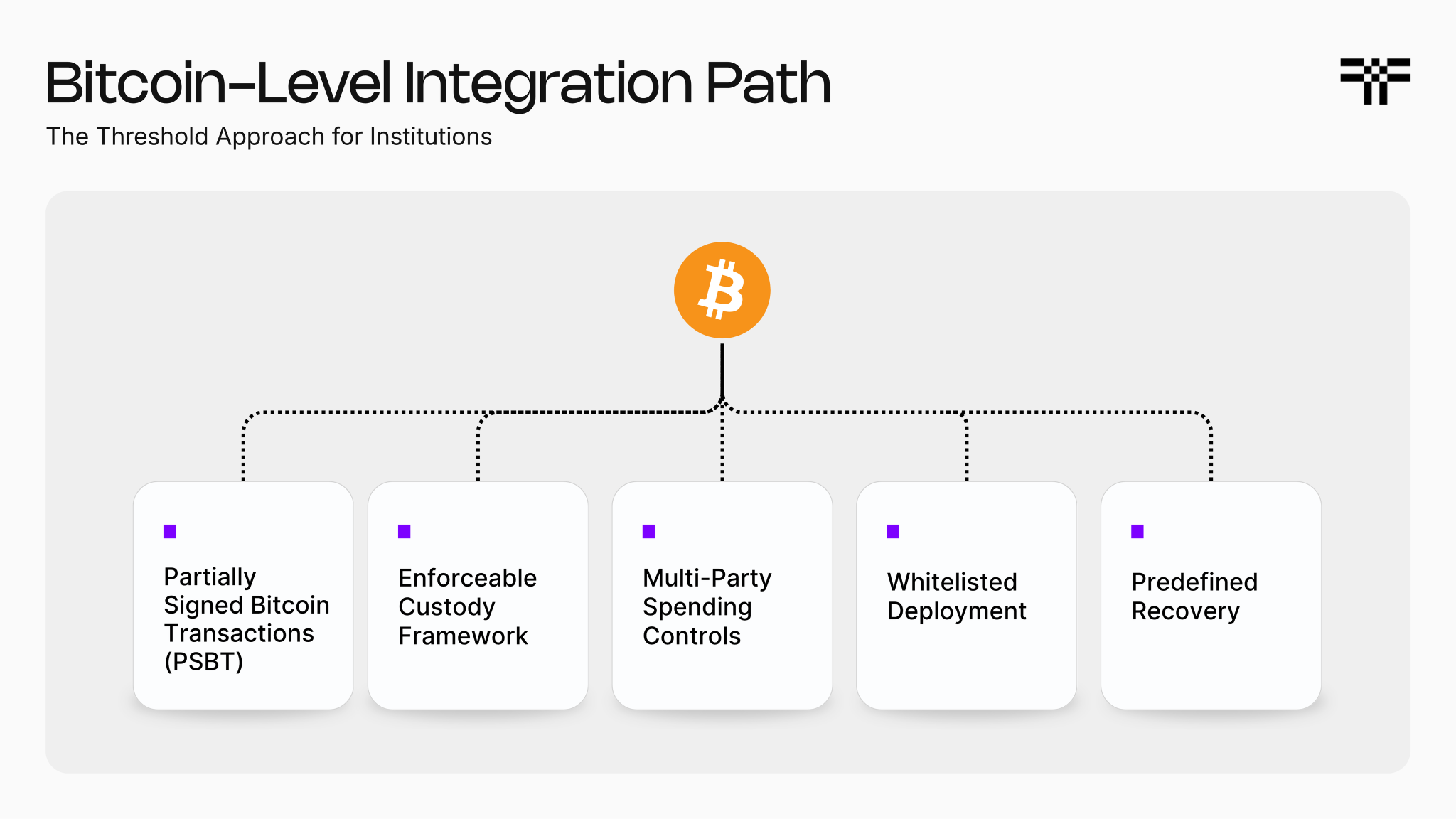
- Partially Signed Bitcoin Transactions (PSBT). Multiple parties construct and approve a transaction in stages, each contributing a signature without ever holding complete control of the keys
- Enforceable Custody Framework. Spending conditions and account rules are written in Bitcoin Script and enforced by the consensus mechanism that secures the Bitcoin network, verifiable onchain by any full node
- Multi-Party Spending Controls. No single entity holds unilateral authority over deployed capital during the term of an agreement, which is the threshold property applied directly to institutional capital
- Whitelisted Deployment. Capital deploys only into risk-assessed, pre-approved onchain lending markets such as Aave, Morpho, Curve, and Yield Basis
- Predefined Recovery. If the signer network becomes unavailable, the depositor recovers the BTC independently after a defined timelock, with no counterparty cooperation required
Custody stays where it is. BTC remains within the holder's existing arrangement, whether a Qualified Custodian such as Anchorage or Fireblocks Trust, an MPC-based custody network, or a self-custody setup, and capital is held in a segregated account identifiable through the Bitcoin UTXO set at all times.
Threshold Cryptography From Paper to Tokenized Bitcoin Security Model
A technique matters when the problem it solves persists and the alternatives fall short. Concentrated key control remains the defining failure mode of digital assets, standardization bodies are formalizing the fix, and institutional adoptions of the mathematics stop short of distributing the trust itself.
Threshold cryptography still matters because the problem never went away, and Threshold Network is where the complete version of the answer has been running in production for six years.
The explainer below shows that mechanism in motion, connecting the argument made here to the distributed key generation and threshold signing that carry it out. It serves as a short visual companion to the analysis above.
Institutions evaluating onchain Bitcoin deployment can review the Verifiable Bitcoin Accounts framework and discuss integration with Threshold's coverage team.
.png)
.png)