Summary
The Threshold app was in maintenance mode from 30 October to 10 November. Two problems surfaced the same night, and we handled them together:
- Suspicious Activity Prompted Precautionary Pause. An unknown address started a key-generation round for a new tBTC wallet. We were already handling a bridge issue reported privately through our bug bounty program, so we paused as a precaution. The next morning, a deposit crafted to exploit that issue was revealed. It was never credited beyond its real value. We have not established whether the round and the deposit were connected. We fixed the bridge issue.
- A critical Linux kernel vulnerability. A flaw in how Linux handles incoming TCP connections affected many node operators' servers. We have not established that it was exploited against any tBTC node. Operators stopped and patched their nodes, and signing resumed as they came back online.
The bridge resumed in stages: the Threshold Council re-authorized Bitcoin proof submission on 7 November, and the app reopened at about 03:00 UTC on 10 November. This post explains what happened, the impact on users and how we resumed.
Suspicious Activity Prompted Precautionary Pause (30 October)
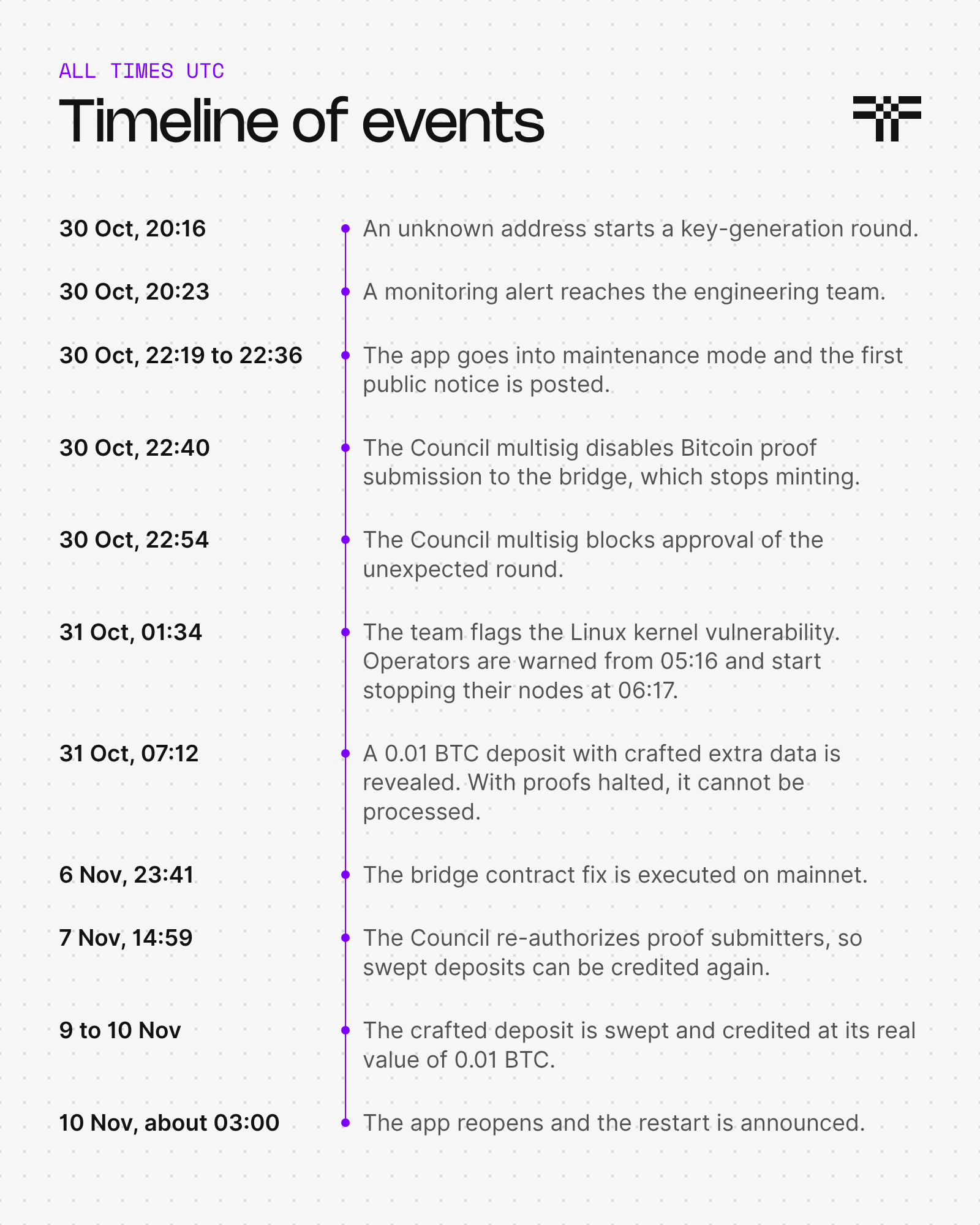
At about 20:16 UTC on 30 October, an unknown address started a wallet-generation round, known as distributed key generation (DKG), which creates a new signing wallet for tBTC deposits. Anyone can start one once the protocol's conditions are met, but the team had not initiated this one. An alert reached the engineering team about seven minutes later.
The timing worried us. Before the incident, researchers had privately reported an issue in how the bridge accounts for deposits through our bug bounty program. A round started by an outsider could have been part of an attack on that issue, so we paused as a precaution.
Within about three hours, we put the Threshold app into maintenance mode and posted a public notice. The Threshold Council multisig disabled Bitcoin proof submission to the bridge, which stopped minting, and blocked approval of the unexpected round. The app stopped taking new deposits and redemptions.
A crafted deposit followed. At 07:12 UTC on 31 October, a 0.01 BTC deposit was revealed to the bridge with crafted extra data, built to exploit the bridge issue. With proofs halted, it could not be processed. Once the bridge fix was live, it was swept on 9 November and credited at its real value of 0.01 BTC, less the normal fees. We have not established that it was connected to the round.
The Linux kernel vulnerability
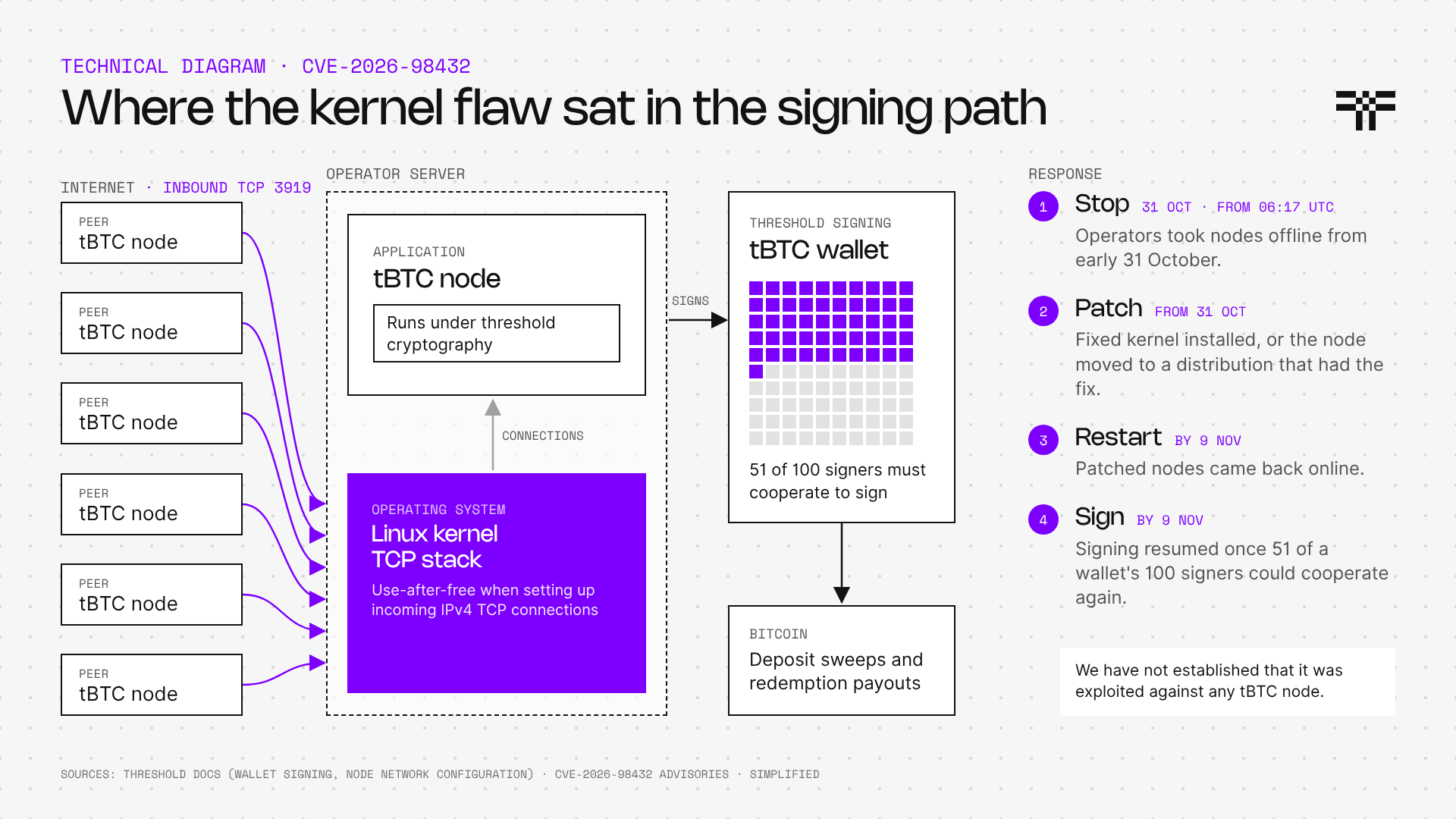
Around the same time, a critical vulnerability, CVE-2026-98432, was disclosed in how the Linux kernel handles incoming TCP connections. tBTC nodes have to accept connections from the internet to reach each other, so several operators' servers were exposed. For several days, some Linux distributions had no fixed kernel.
We have not established that it was exploited against any tBTC node. Because each node holds key shares, we treated it as urgent anyway. From early on 31 October, operators stopped their nodes and patched them. Where no fixed kernel was available yet, we asked them to migrate to a distribution that already had the fix.
A wallet needs more than half of its signer seats to sign, so signing could resume only once enough operators were back online.
How we fixed it and resumed
We fixed the bridge issue, upgraded the bridge through the Council multisig and its timelock, and reopened the app on 10 November.
Impact
Our review found no unexplained bitcoin outflow and no new unbacked tBTC.
We checked public chain data for 25 October to 12 November, covering the bridge contracts and the 57 registered tBTC wallet addresses:
- Every one of the 76 bitcoin transactions out of tBTC wallets in that window matches a proof on the bridge: 45 deposit sweeps and 31 redemption payouts. Every redemption payout went to the address the redeemer asked for.
- At 140 sampled checkpoints, the difference between the bitcoin held at registered wallet addresses and the bridge's ledger liabilities was unchanged, after allowing for the delay between Bitcoin transactions and their proofs on Ethereum.
- In that scope, no deposit was credited at more than its real value, including the crafted 0.01 BTC deposit, and we found no tBTC minted without a deposit.
- There were no redemption timeouts, fraud challenges or slashing.
- On 31 October the tBTC wallets held 4,320.46 BTC against 4,185.155 tBTC in circulation.
The pause. The app did not take new deposits or redemptions from 30 October until 10 November, and proof submission, which minting depends on, was disabled from 30 October to 7 November. Holders could still hold, transfer and use tBTC throughout, but could not move between BTC and tBTC through the app.
Partners. Aave froze tBTC on V3 Ethereum Core on 31 October, and Gauntlet was reported to have added a tBTC market to an exclusion list. These measures are separate from the bridge reopening, and lifting them is each partner's decision.
Technical details
What the bug allowed. When someone reveals a deposit, the bridge parses the Bitcoin funding transaction to find the deposit output and its amount. Before the fix, the parser did not insist that the transaction's input and output lists were well formed and fully consumed: trailing bytes and an empty input list were accepted. A carefully encoded funding transaction could therefore make the bridge record a deposit that did not match a real deposit output, a phantom deposit. The report showed several ways to build one, including through revealDepositWithExtraData.
A phantom record becomes value when a wallet sweeps. The sweep logic looked each input up in the deposit records before checking whether it was the wallet's own main UTXO, the output that holds the wallet's balance. A phantom deposit recorded at a wallet's main UTXO would have been credited with that wallet's whole balance, minting tBTC with no new bitcoin behind it. The same ordering could also have frozen a wallet by making its sweep unprovable. A related gap let an output that a moving-funds transfer had already claimed be swept again as a deposit.
What happened on chain.
- 30 October, 20:16 UTC. An address funded that morning called
requestNewWalletand started the key-generation round. We have not established a connection between this round and the deposit below. The Council approved the round's result on 14 November, and it is now a tBTC wallet. - 31 October, 06:20 and 07:12 UTC. A 0.01 BTC deposit was funded on Bitcoin, then revealed through
revealDepositWithExtraDatawith crafted extra data, in the shape the report describes. The revealing address had received its ETH from a Tornado Cash withdrawal on 27 October. - Why it never paid out. The bridge credits a deposit only when a sweep proof lands on Ethereum. The night before, the Council had removed the only account allowed to submit proofs, so no sweep could be credited until the fix was live. Optimistic minting, which credits before the sweep, has been paused since May.
- After the fix. The deposit was swept on 9 November and its proof landed at 00:10 UTC on 10 November. The bridge credited 996,950 sat to the vault and 2,000 sat to the treasury: the 1,000,000 sat deposit less the treasury and sweep fees. The vault minted 0.0099695 tBTC.
What the fix changed.
Two bridge libraries changed, and the bridge's storage layout, ABI and events did not.
- Reveals: the funding transaction's input and output lists must be well formed and consumed exactly. An empty input list is rejected.
- Sweeps: an input at the wallet's main UTXO is always treated as the main UTXO, checked before the deposit records. An output already claimed by a moving-funds transfer cannot be swept as a deposit.
- Limit: the fix is prospective. It stops new phantom records but does not rewrite existing ones. The 16 November review found no unexplained credit in the scope described under Impact.
For integrators. Revealing a deposit now costs roughly 4,500 to 33,000 more gas, depending on the size of the funding transaction, so relayers with fixed gas limits must re-estimate. Reveals of malformed funding transactions now revert.
Credit. A security researcher at OtterSec first reported the vulnerability via Immunefi.
If you find a security issue in tBTC or Threshold, please report it privately through our bug bounty program or to [email protected]. The report behind the bridge fix came in that way, and we are grateful to the researchers, the node operators who patched and restarted at short notice, the Threshold Council, and the partners who worked through the pause with us.
The Bridge is now fully operational, you can check the latest stats by visiting the app.