
Overview
While a full discussion of SPV proofs is outside the scope of this document, it is important to develop a working understanding of their properties, as many system-critical processes rely on the SPV security assumptions. SPV proofs are used during the funding, redemption, and fraud processes to provide the host chain with information about the state of the remote chain. Practically speaking, there is no other way for the host chain to learn about the state or history of the remote chain.
Objectivity in Proof of Work
The SPV proofs used in this system rely on a property of Proof of Work (PoW) called objectivity. Simply put, proof of work cannot be forged and no outside information is needed to check its validity. Without knowing the history of the chain, we can examine a Bitcoin block header and determine (probabilistically) how many hashes were performed to generate it. The number of hashes used to generate a header represents an unforgeable cost inherent to that header, independent of its context or history.
Contrast this with Proof of Stake, where the cost of generating a header is dependent on the entire history to date. We cannot know whether staker signatures represent the current validator set without complete history. In other words, Proof of Work in isolation still carries meaning, while Proof of Stake in isolation does not.
2026 note on PoS verification:
Since this document was originally written, several PoS chains have matured significantly. No production system, however, has demonstrated a stateless PoS verification primitive equivalent to stateless SPV for Bitcoin. This section concerns itself only with verification of Proof of Work, and future versions of the system utilizing SPV inspection of PoS systems are left for another day.
Security Model
In Nakamoto Consensus, each node follows the heaviest valid chain. Heaviest refers to the objective proof of work metric. The chain with the most accumulated work is deemed the heaviest chain. Validity within the consensus is more involved. Conceptually, nodes agree to evaluate new information according to a set of rules, and to reject anything that does not meet those rules. In practice, these rules define blocks consisting of headers and transactions, describe the format of transactions, and provide some user-programmable rules like Script and the EVM.
Protocol-following nodes will always make the same validity decisions and will always choose the heaviest header chain containing only valid transactions and blocks. Therefore honest nodes will always reach the same state, which is to say, they will always reach consensus.
The SPV security model is strictly weaker than the Nakamoto Consensus model, but still sufficient for our purposes. The SPV model checks work on headers but enforces only a small subset of the validity rules. In essence, SPV verifiers assume that miners will not spend resources producing proofs of work on top of invalid blocks or transactions. They check validity of some set of headers, including verifying the work included in those headers, but do not verify each transaction. Instead, SPV verifiers check only transactions in which they have some interest. In the context of tBTC, we are interested only in specific UTXOs on the Bitcoin blockchain, so we validate only the transactions and headers related to those UTXOs.
When the assumption fails, and significant work is put on top of invalid transactions, the security model may also fail. We call these "fake" proofs and "fake" headers, because they are not semantically valid Bitcoin transactions or headers. Fake proofs will be extremely rare. Our argument against them is rooted in the objective economics of Proof of Work. If a miner chooses to devote resources to producing work on top of an invalid transaction, she must give up mining rewards while still bearing the electricity and hardware costs of mining. She gives up mining rewards because the invalid transaction may never be included in the main Bitcoin chain; it will be rejected by all fully validating nodes. Producing a fake proof therefore has a large inherent cost. The system is economically secure so long as the cost of producing a fake proof is high and the value that can be gained is orders of magnitude less than that cost.
The security of SPV systems also benefits from a built-in assumption of the Nakamoto Consensus model: no attacker has greater than 50% of the hashrate. Assuming that is true, no attacker can generate Bitcoin proofs of work faster than the main Bitcoin blockchain. This implies that honest headers are generated (within the tolerance of the Poisson distribution) before any dishonest header.
Hashrate race: honest chain vs 25% attacker
If an attacker controls 1/n of the current Bitcoin hashrate (where n ≥ 2), then honest headers are generated on average n − 1 times faster than the attacker's headers.
Worked example: an attacker controlling 25% (1/4) of the Bitcoin hashrate generates a header on average every 40 minutes. The main chain, slowed by the loss of that 25%, generates a header every 13.33 minutes — three times faster (n = 4, so n − 1 = 3).
To take advantage of this, the proof must commit to some recent information that was previously unknown to the attacker (e.g. a past block header, or a new public key hash). This provides a lower bound on the time at which the attacker begins to generate a false proof.
Average time to produce one Bitcoin block header, assuming Bitcoin's 10-minute network target at 100% hashrate.
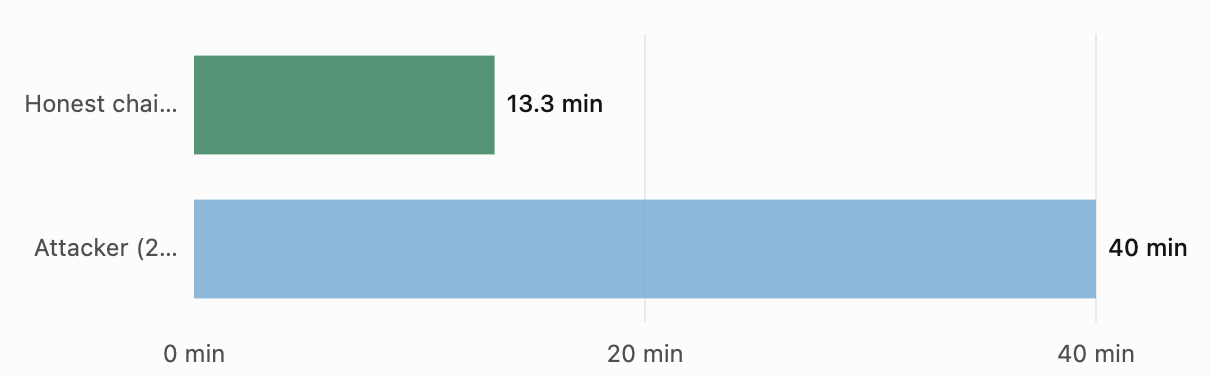
Attacker: 10 / 0.25 = 40 min. Ratio: 3x faster for the honest chain, matching the n − 1 formula above.
Relays
The most conceptually straightforward SPV system is a relay. In a relay system each Proof of Work header is submitted to and verified by the host chain. The host chain smart contracts keep track of the best known header, and all past headers seen. An SPV proof in a relay system demonstrates that a transaction is confirmed by the best-seen header and is deep enough that its disconfirmation is unlikely. Each additional header in a relay, as in the consensus it tracks, secures all previous headers. So we grow more certain of older chain events over time.
tBTC v2 uses a Light Relay, not a classical relay
Since tBTC v2 launched under Threshold Network in 2022, the system uses a Light Relay (LightRelay.sol), a hybrid design that keeps the recency guarantees of a relay without storing every header from genesis.
The Light Relay stores current and previous epoch difficulty only, anchored to Bitcoin's 2016-block difficulty retarget cycle. A retarget update requires proofLength × 2 block headers (before and after the retarget) submitted sequentially. This provides sustainable state costs on Ethereum while preserving objective proof-of-work verification.
The Light Relay design is also used by BOB (Bank of Bitcoin) as its Bitcoin light client, which describes it as production-ready and well-optimized for gas consumption.
Stateless SPV
Where relays decline to check validity, stateless SPV systems both decline to check validity and fail to follow the heaviest chain. In fact, a stateless SPV system does not track anything at all. Instead stateless SPV proof relies entirely on the objective work present in a discrete slice of headers. A stateless SPV proof consists of one or more transactions, merkle proofs of inclusion for those transactions, and a set of consecutive headers on top of those transactions. A verifier can then inspect the headers, and give the proof an objective quality score based on the amount of work in those headers. Anyone interested in using the state and history information in the stateless SPV proof's information can determine whether to accept or reject it based on the proof's quality.
Stateless SPVs were spearheaded by Summa in a cross-chain auction system; their compelling advantage is size and cost-efficiency. A stateless SPV proof is less than 1KB, all of which can be discarded after validation. A relay, on the other hand, stores each header on-chain. This means a relay will consume linearly increasing state space over time. Maintenance costs are already unsustainably n high, as evidenced by the failure of BTCRelay in December 2017. Given the already high cost of on-chain storage and the likely introduction of state rent in major host chain candidates, relying on a stateful relay seems short-sighted. A high-state system that is viable today may not be viable in the future.
We argue that for recent transactions stateless SPV's security is equivalent to a relay's. An attacker would have to spend the same number of hashes to provide the relay with fake headers as it would to provide the stateless SPV verifier with a stateless proof with sufficient work. However, compared to relays, stateless SPV proofs do not gain security over time without extending each proof to include new headers. It is important to this argument that the recency of the transaction is known, without this, an attacker could begin to generate a proof well in advance of proving time, essentially getting a head start on the main chain. Relays get recency assurances at each block, as each new header must reference the header immediately preceding it, but a stateless SPV proof must get its recency from some outside source.
BTCRelay's economic collapse
Maintenance costs for a classical relay proved unsustainable, evidenced by the collapse of BTCRelay. During Ethereum congestion in late 2017 (the CryptoKitties period), relayer economics broke: gas costs to submit headers exceeded the fees relayers earned, and the last relayer submissions stopped shortly after.
BTCRelay's contract still exists on Ethereum mainnet at 0x41f2...c3d4 but is considered abandoned. The Serpent language it was written in was deprecated around the same period, and the GitHub repository was formally archived in February 2025.
The core lesson holds: given the already high cost of on-chain storage and the likely introduction of state rent in major host chain candidates, relying on a classical stateful relay is short-sighted. A high-state system that is viable today may not be viable in the future. tBTC v2 addresses this with the Light Relay design described above.
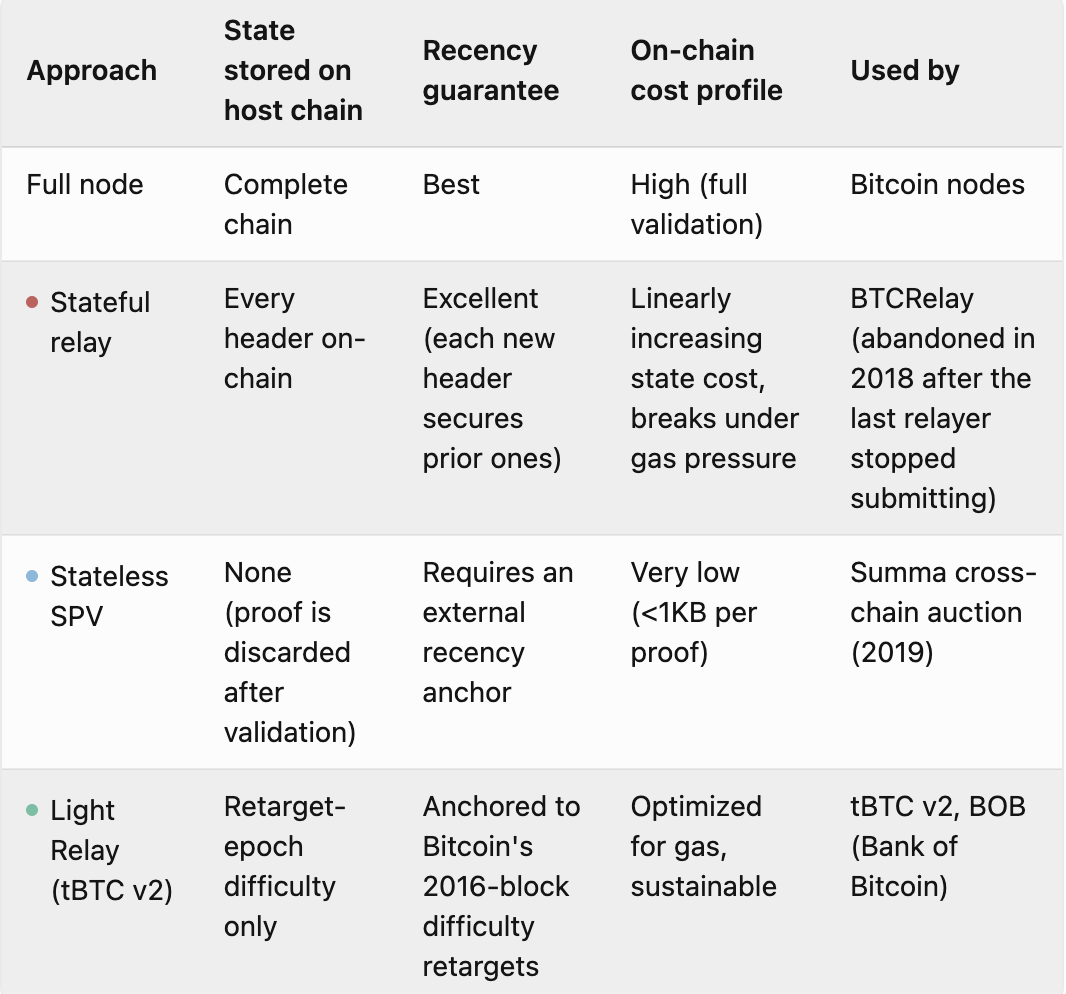
Comparison of verification approaches
Four approaches to verifying Bitcoin state on another chain, ordered by weight of state kept on the host chain.
Learn how you can integrate tBTC SDK on your protocol
.png)

.png)