.png)
Threshold Network has been making Bitcoin liquid and programmable since 2020, backed by trusted, battle-tested security. With over five years of zero breaches and billions in cross-chain volume, tBTC has proven itself as the trust-minimized standard for Bitcoin in DeFi.
That standard finally landed on Sui last July, and the results were immediate: Bitcoin became one of the fastest-growing assets in the ecosystem. Now, Threshold Network and Sui are doubling down on those efforts with the Phase 2 expansion of tBTC integration, bringing leveraged yield strategies and seamless cross-chain flows to users worldwide.
Phase 2 marks a decisive shift: Bitcoin isn’t just entering DeFi—it’s becoming an integral part of it.
From Proof to Momentum: Phase 1 in Review
When Phase 1 launched earlier this year, it set out to answer one question:
Would users adopt Bitcoin on Sui if they had a secure, trust-minimized way to bridge it?
The answer was proven in numbers:
- 20% of Sui’s TVL in Bitcoin DeFi assets: Bitcoin quickly became a leading asset in the ecosystem.
- $10M tBTC supplied on Alphalend: Users didn’t just bridge BTC—they lent it, borrowed against it, and engaged in credit markets.
- Thousands of campaign participants: Multiple activation campaigns showed strong grassroots demand.
- $2.8M+ liquidity added to vaults and pools

“Phase 1 proved that there is a growing demand for trust-minimized bitcoin onchain—it’s here, and Sui is the perfect home for it. When users bridge Bitcoin, supply it to markets, and actively borrow against it, that’s the clearest signal of product-market fit.”
-Maclane Wilkison, CEO and Co-Founder of Threshold Labs,
Phase 1 showed that the foundation was strong. Phase 2 builds on it.
tBTC x Sui Phase 2 | Threshold Network
Phase 2: Scaling Bitcoin DeFi on Sui
Bitcoin represents more than 50% of the global crypto market cap, yet its integration into DeFi is still in its early stages. Phase 2 of tBTC on Sui aims to change that, unlocking infrastructure that makes BTC programmable, composable, and yield-bearing.
- Seamless Cross-Chain Flow via Wormhole: As tBTC’s interoperability partner, Wormhole enables secure, seamless transfers between Ethereum and Sui via the Threshold UI.
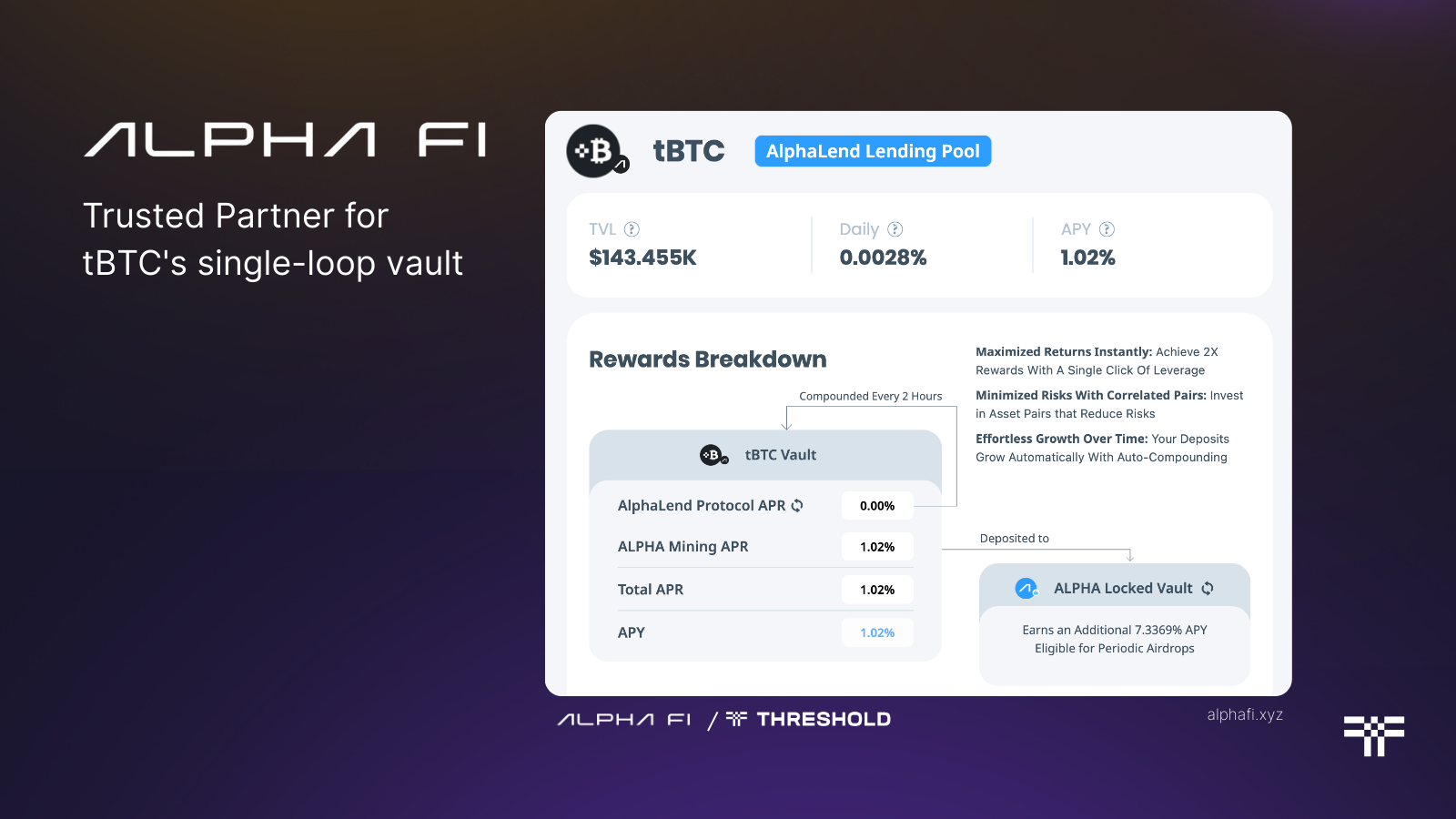
- AlphaFi Auto-Looping Vault: The AlphaFi vault compounds lending rewards multiple times a day. Deposited tBTC is looped in Alphalend, optimizing yields through automated lending/borrowing cycles, with low fees and no entry/exit costs.
- Expanded Liquidity Options for tBTC on Sui: New tBTC pool pairs are now live on Bluefin, enhancing composability across BTC assets. These pools further strengthen Bluefin’s position as a key liquidity venue in Sui’s growing BitcoinFi ecosystem.
- Activation Campaigns with Sui Ecosystem: upcoming new campaigns are designed to guide both new and experienced DeFi participants in learning how to effectively utilize their tBTC within the Sui ecosystem, helping them unlock deeper utility for their Bitcoin.
- Upcoming Launch of a new structured vault product: This new structured product will highlight more earning possibilities for tBTC

“Bitcoin DeFi is having its breakout moment on Sui, and it’s being powered by community demand and innovative builders like Threshold who are meeting that demand. Sui has become a home for Bitcoin liquidity in record time as users look to put their once static Bitcoin to use in Sui’s dynamic onchain environment.”
- Adeniyi Abiodun, Co-Founder and Chief Product Officer at Mysten Labs
Why This Matters
For years, Bitcoin has been sidelined in DeFi. Threshold Network’s tBTC changes that, allowing BTC to move across ecosystems like Ethereum, Arbitrum, Base, BOB, and now Sui, without custodians or compromises.
Phase 2 isn’t just a technical milestone. It’s the start of Bitcoin taking its rightful place as the foundation of onchain financial markets.
Get Involved
Here’s how to participate in Phase 2 today:
- Bridge tBTC from the Ethereum Network to Sui:
https://sui.threshold.network/ - Access Lending Options and tBTC Pools on Bluefin:
https://trade.bluefin.io/lend - Try AlphaFi Auto-Looping Vault:
https://alphafi.xyz/portfolio/ALPHALEND-SINGLE-LOOP-TBTC - Keep an eye out for upcoming community campaigns:
https://app.galxe.com/quest/Threshold/GCKPitmf4Y - New Pool Pair (tBTC–USDC):
https://trade.bluefin.io/deposit/0x1f121fb96bb1f57ac07564e7fad3a0412a6958701da1a66496b70f7ea15e051e - New Pool Pair (xBTC–tBTC):
https://trade.bluefin.io/deposit/0x4ac34b740c30972b2ba10c417aa5a446fd0fe90a2bb62f9091683423f61202ab
About Threshold Network
Threshold Network is the decentralized protocol behind tBTC, a fully non-custodial, 1:1 Bitcoin-backed asset secured by a 51-of-100 threshold signer model. With over $700M in TVL and $3.8B in bridge volume, Threshold is the most battle-tested, trust-minimized Bitcoin infrastructure in DeFi. Learn more at https://threshold.network.
About Sui
Sui is a first-of-its-kind Layer 1 blockchain designed for fast, secure, and accessible digital asset ownership. With parallel execution, sub-second finality, and scalable architecture, Sui enables rich on-chain experiences at speed and low cost. Learn more at https://sui.io.
Threshold Network brought Bitcoin to Sui in July. Now, with Phase 2, it’s doubling down—expanding Bitcoin’s role from proof of adoption to unstoppable momentum in DeFi.
Lending and vault opportunities for tBTC
.png)