.png)
Before we can define and map out the unique features of threshold cryptography, it helps to start with a definition of cryptography itself. Cryptography is a process for securing information as it passes between two parties, keeping it protected from third-party adversaries and the general public. The need for that security can take several forms, from keeping information confidential to guaranteeing that it has not been tampered with. Digitally, this takes the form of writing codes as well as solving them. Encryption turns intelligible information into unintelligible information, and decryption deciphers the unintelligible information back into its original, intelligible form.
When people mention cryptography in today's context, they are usually referring to its application in computer science, and increasingly to cryptocurrencies and DeFi applications.
The Origins of Threshold Cryptography
It is difficult to pinpoint a precise origin for threshold cryptography or to attribute its invention to a single individual. Early on, only the military and governmental organizations made use of it. A handful of milestones mark how the field developed and eventually reached commercial use:
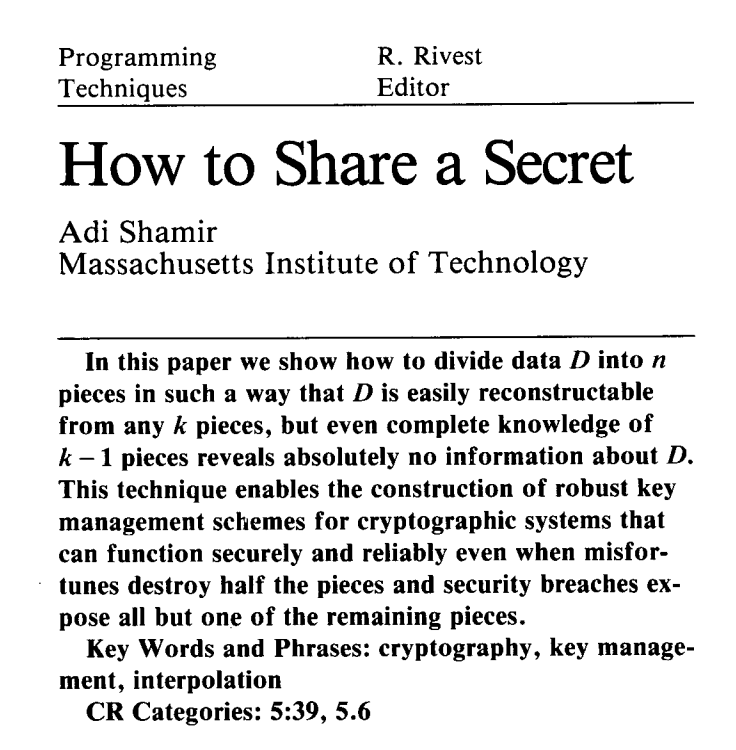
- 1979. Adi Shamir's paper How to Share a Secret, published in Communications of the ACM, introduced the secret-sharing scheme that still underpins much of the field.
- 1994. Alfredo De Santis, Yvo Desmedt, Yair Frankel, and Moti Yung published what is often credited as the first system with complete threshold properties for a trapdoor function such as RSA, together with a proof of security.
- 1990s. CertCo, a startup spun out of Bankers Trust, built one of the earliest real implementations, developed for the planned deployment of the original Secure Electronic Transaction standard for credit card payments.
- 2012. After a series of large password-database compromises, RSA Security released software based on threshold cryptography to protect stored credentials, moving the technique beyond the high-security institutions that had relied on it until then.
How Threshold Cryptography Works
Threshold cryptography systems are defined by how they distribute information across a "cluster," and that distribution is what makes them so secure. In cryptographic computer systems, this cluster takes the form of a number of fault-tolerant, independent computers. Fault-tolerance refers to the ability of a system, such as a computer, to keep functioning despite a software or hardware failure.
In modern cryptography, most methods were developed to serve one sender and one receiver. The main distinction of threshold cryptography, and the primary motivation behind its development, was to provide techniques for scenarios involving multiple senders or multiple recipients. Like all cryptographic systems, a message encrypted through a threshold cryptosystem uses a public key and a private key. Within a threshold system, though, the private key is shared among the individual, independent participants in the cluster.
To decrypt a message, a predetermined number of cluster participants, the "threshold," must take part by executing the decryption protocol. The threshold is typically set to reflect a majority of the cluster.
A worked example. In a cluster of 10 with the threshold set at 7, at least 7 participants have to cooperate before any decryption can succeed. Any group smaller than that learns nothing, and the message stays sealed.
Collaboration never requires keyholders to see one another's portions of the key. Threshold cryptography ensures they can work together while preserving informational privacy.
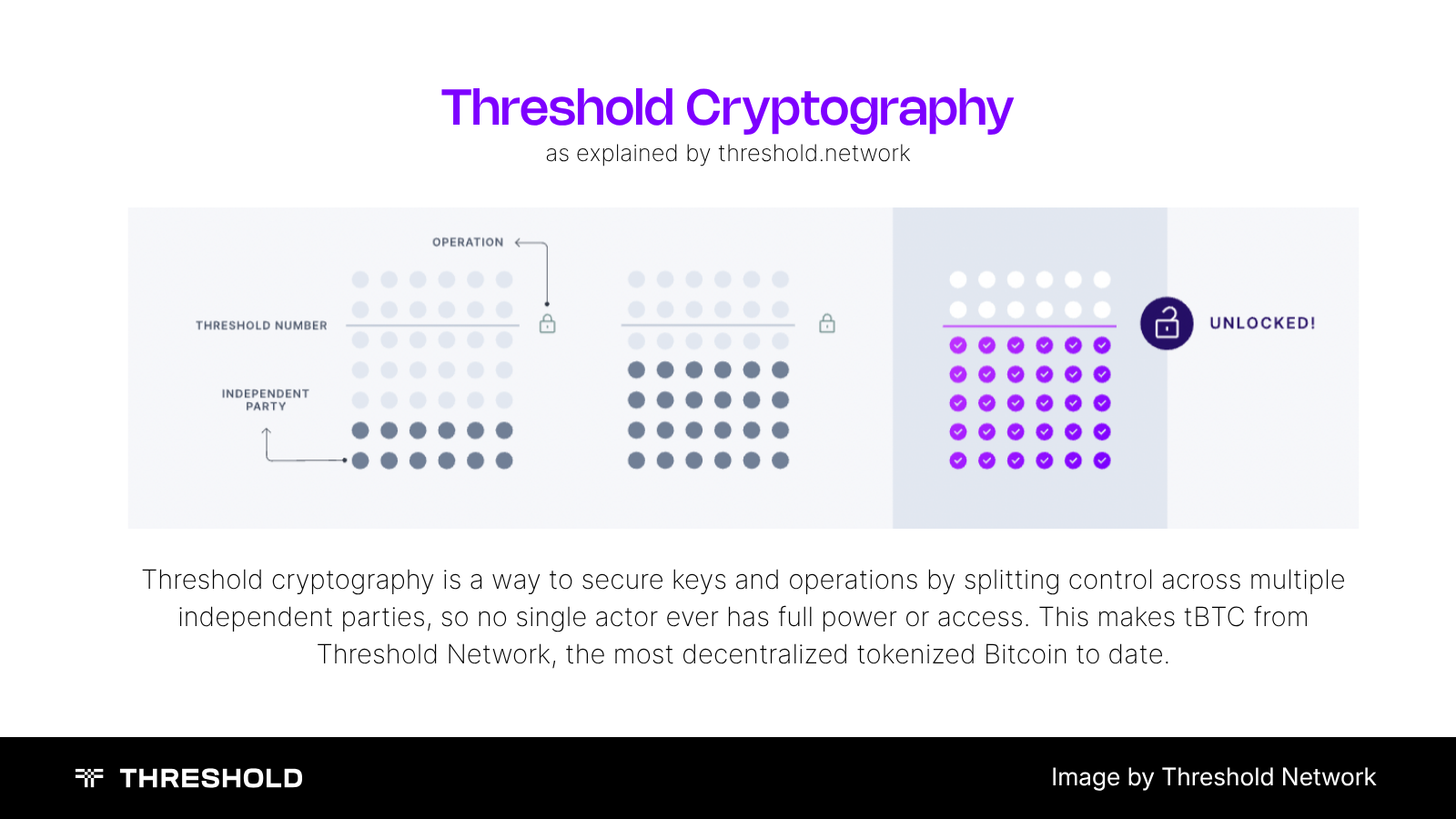
The explainer below walks through the same mechanism visually, from how a key is split into shares to how a threshold of operators produces a single valid signature. It brings the process to life in motion, a companion piece to this article.
Benefits of Threshold Cryptography
Threshold cryptosystems are designed to preserve one of the original motivations behind cryptocurrencies: removing trusted intermediaries and the centralized, "too-big-to-fail" actors that come with them. They provide the formal, structural mechanics for many decentralized cryptographic technologies, and two properties do most of the work.
- No dependence on a single trusted party. Users avoid relying on one authority to protect their data and assets, which removes a point that could be censored or corrupted. Bad-faith behavior is still possible, but for a group of members to collude they would first have to reach the threshold, and at that scale the outcome functions as a form of majority rule.
- Fault tolerance. The system does not depend on every participant showing up. If a member loses their key material or cannot take part in the protocol, work continues, and no single individual can create a bottleneck by accident or by design.
Taken together, these properties leave the system with no single point of failure.
Threshold Cryptography in Practice: Threshold Network and tBTC
Threshold Network applies threshold cryptography to bring Bitcoin onchain without a centralized custodian. Its core product, tBTC, is a trust-minimized, tokenized form of Bitcoin. Rather than handing coins to an intermediary in exchange for an IOU, users mint tBTC through a rotating group of independent node operators who secure deposits using threshold signing. Building on that foundation, Verifiable Bitcoin Accounts extend the same trust-minimized approach to institutional Bitcoin deployment.
Threshold cryptography shapes more than the applications themselves. It also informs how the network is governed. Threshold Network is managed by Threshold DAO, a community that votes collectively on major decisions facing the network and on updates to its governance process. Anyone holding Threshold work tokens (T) can take part in governance. Token holders can also run a node and stake their tokens, contributing to the security and functionality of Threshold's applications.
Learn more about tBTC, bridging Bitcoin onchain, and market opportunities
.png)